
workout routine

This workout plan designed to build muscle 3X faster for effective strength training

This Workout Plan Builds Muscle 3X Faster (STEAL THIS)

Triple Gain Blueprint

This plan is built for lifters who want bigger muscle faster without gimmicks. It factors in heavy compound lifts, strict progression, focused recovery, and the nutrition tweaks that actually move the needle. If you want a simple, repeatable template for accelerating hypertrophy, this is it — and it works whether you prefer animal or plant proteins; see one breakdown on lean meat vs high-fat meat benefits for how protein quality affects recovery.

This Workout Plan Builds Muscle 3X Faster (STEAL THIS)

Why this approach speeds growth

  • Focus on high-quality compound lifts (squat, deadlift, bench, row, overhead press) to recruit maximum fibers and stimulate systemic anabolic responses.
  • More frequent stimulation: target each major muscle 2–3 times weekly rather than once — shorter, sharper sessions beat long, infrequent marathons.
  • Progressive overload with micro-increments: small, consistent increases in weight or volume beat sporadic big jumps and reduce injury risk.
  • Nutrition and recovery tuned to support the workload: protein timing, total calories, sleep, and deloads.

Weekly sample (8–12 week block)

  • Day 1 — Heavy lower: Squats 5×5, Romanian deadlift 3×8, calf raises 3×12.
  • Day 2 — Upper push/pull: Bench 5×5, bent-over rows 4×6, face pulls 3×12.
  • Day 3 — Active recovery or conditioning: low-impact cardio, mobility.
  • Day 4 — Volume lower: Front squats 4×8, lunges 3×10, hamstring curls 3×12.
  • Day 5 — Upper volume: Overhead press 4×6, incline dumbbell press 3×10, pull-ups 3×AMRAP.
  • Day 6 — Optional weak-point work: arms, traps, calves or technique work.
  • Day 7 — Rest.

Programming tips that triple results

  • Keep rep ranges focused: 4–6 reps for strength and size in compound lifts, 8–12 for accessory hypertrophy.
  • Track every set and aim for small weekly progressions (0.5–2.5 kg increases or an extra rep).
  • Manage fatigue with planned deloads every 4–6 weeks (drop volume 30–50%).
  • Use tempo and pause reps for added stimulus without heavy load increases.

Nutrition and recovery

  • Aim for a slight calorie surplus (200–350 kcal/day) while prioritizing ~0.8–1.2 g protein per pound of bodyweight for most lifters.
  • Spread protein evenly across meals to support synthesis throughout the day.
  • Strategically use carbohydrate timing around training for performance and glycogen replenishment.
  • Sleep 7–9 hours and prioritize stress management; muscles grow when you recover.

Accessory choices and technique

  • Pick accessory lifts that address your sticking points: glute ham raises for hip drive, rows for upper-back thickness, and farmer carries for core and grip.
  • Maintain clean technique on heavy sets; use a spotter or safety setup when pushing near failure.
  • Shorten sessions to 45–75 minutes to limit systemic fatigue and improve consistency.

Adapting for dietary preferences

  • Both animal-based and plant-based diets can support rapid muscle growth when total protein and calories are adequate — see research on how you can build muscle on a plant-based diet for implementation ideas. plant-based muscle research

Common mistakes to avoid

  • Chasing volume without progressive load increases.
  • Ignoring recovery and sleep.
  • Skipping compound lifts in favor of machines that don’t transfer as well to systemic growth.
  • Expecting dramatic overnight changes; compounding progress week-to-week is the goal.

This Workout Plan Builds Muscle 3X Faster (STEAL THIS)

Conclusion

If you want a proven, fast path to bigger muscles, pair this blueprint with a reliable strength routine like the StrongLifts 5×5 quick start guide to lock in consistent, measurable progress.

This Workout Plan Builds Muscle 3X Faster (STEAL THIS) Read More »

, , , ,
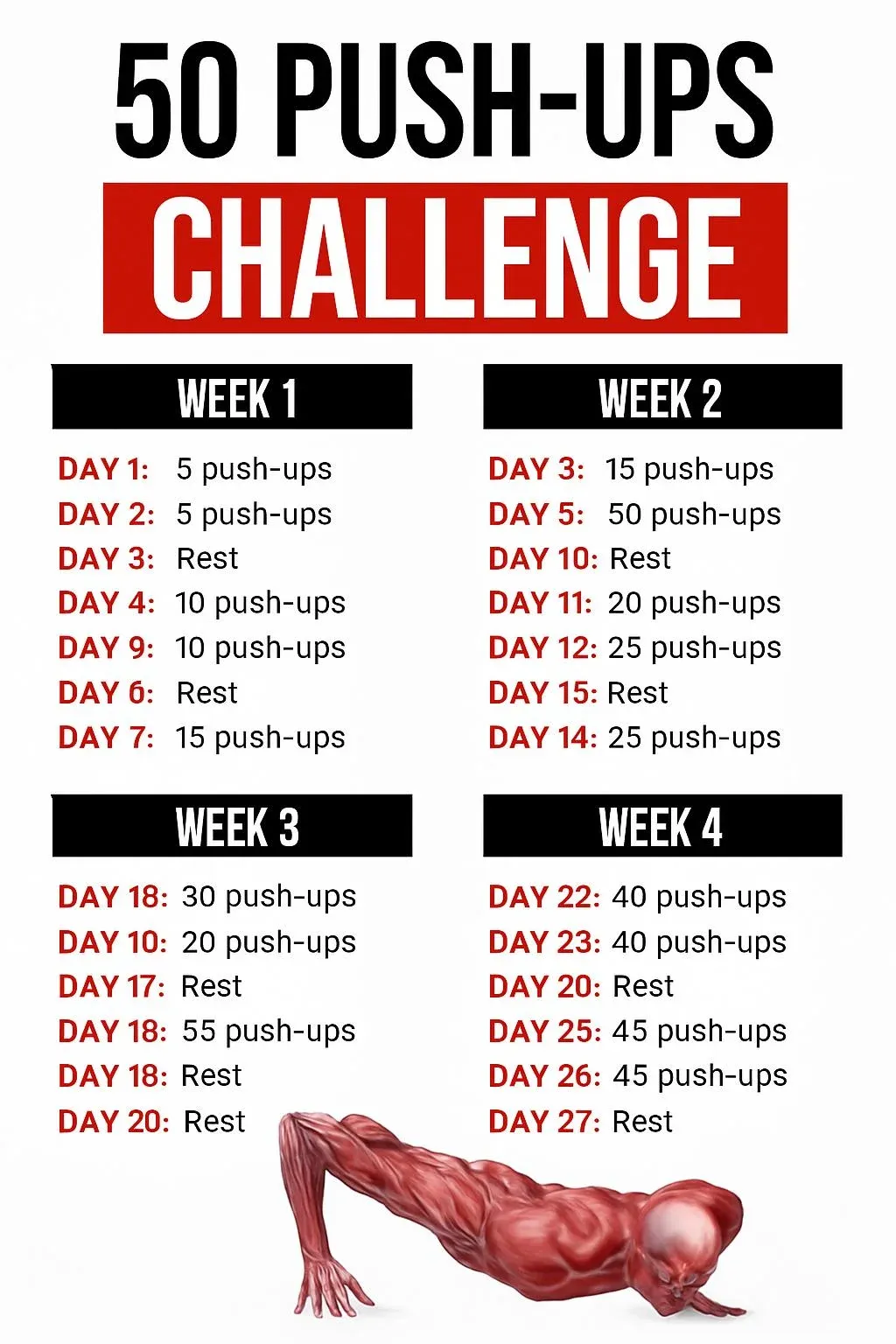
Person performing push-ups as part of a 4-week fitness challenge to reach 50 push-ups.

How to Do 50 Push-Ups: A 4-Week Challenge

How to Do 50 Push-Ups: A 4-Week Challenge

Push-ups are one of the most efficient, no-equipment exercises you can do to build upper-body strength, core stability, and muscular endurance. Whether you’re starting from a few reps or working up from zero, a structured 4-week plan can take you to 50 consecutive push-ups with consistent practice and smart recovery. Try pairing push-up training with targeted back work to keep your shoulders healthy and your posture strong.

How to Do 50 Push-Ups: A 4-Week Challenge

Why 50 push-ups?

  • It’s a measurable goal that tests muscular endurance across chest, shoulders, triceps, and core.
  • It builds confidence and creates a foundation for more advanced bodyweight moves.
  • It’s scalable: you can adapt the plan whether you can do 0, 10, or 30 reps today.

Fundamentals of good push-up form

  • Hands should be slightly wider than shoulder-width, fingers spread.
  • Body forms a straight line from head to heels — no sagging hips or pike.
  • Elbows track at a roughly 45-degree angle from your torso.
  • Lower until your chest is an inch or two from the floor, then press up fully.
  • Breathe in on the descent, out on the ascent.

Warm-ups and mobility (5–7 minutes)

  • Light jogging or jumping jacks (1–2 minutes).
  • Shoulder circles and band pull-aparts to activate rotator cuff and scapular stabilizers.
  • 10–15 scapular push-ups (protract/retract shoulder blades) to prime upper-back control.

The 4-week progression
This plan assumes you do the program 3–4 times per week (e.g., Monday, Wednesday, Friday, optional Sunday). On off days, do light mobility or a short walk.

Week 1 — Build volume and consistency

  • Test day (Day 1): Perform one maximal set of push-ups to find your starting point (don’t go to failure on training days).
  • Training days: 5 sets of 50% of your max reps with full rest between sets (2–3 min). If your max is 10, do 5 sets of 5.
  • Add one daily set later in the day of 60% of your max as a “grease the groove” mini-set to build neural efficiency.

Week 2 — Increase set density

  • Training days: 6 sets of 60% of your max. Reduce rest slightly (90–120 seconds).
  • Once per week, perform 2 “ramp” sets: start with light sets and finish with a near-max set to push endurance.
  • Introduce incline or knee push-ups for 1–2 sets if you need to keep total volume manageable.

Week 3 — Push closer to goal reps

  • Training days: 4 working sets designed as two heavier sets and two endurance sets.
    • Set 1 & 2: 75–85% of your current max (enough to fatigue without failing).
    • Set 3 & 4: As many reps as possible (AMRAP) but stop 1–2 reps shy of failure.
  • Add one day of tempo push-ups: slow 3-second descent and controlled 1-second up, 4 sets of moderate reps. Tempo work increases time under tension and control.

Week 4 — Peak and test

  • Reduce frequency slightly to allow fresh muscles: 3 solid sessions early in the week.
  • Early-week sessions: two heavy sets (near max) and one long set (aim for 70–90% of 50).
  • Test day (end of week): Attempt 50 consecutive push-ups. Warm thoroughly; attempt once when fresh.

Modifications and regression options

  • Incline push-ups (hands on bench/wall) reduce load for beginners.
  • Knee push-ups keep the pattern but lower resistive demands.
  • Eccentric-only (slow negatives) help if you can’t push up yet: step up (or have partner help) and lower slowly to the floor.

Accessory work to support push-up gains

  • Planks and hollow holds to strengthen core stability.
  • Dips or tricep-focused extensions for lockout strength.
  • Rows and posterior-chain work to balance the pushing volume — consider the primer on back development in the article 50 healthy snacks to fuel recovery when planning nutrition and recovery strategies.

Recovery, sleep, and nutrition

  • Aim for 7–9 hours of sleep nightly; muscle adaptations happen during rest.
  • Keep protein intake sufficient (rough guideline: 0.6–1.0 g per pound bodyweight for active trainees).
  • Hydrate and include anti-inflammatory foods (fruits, vegetables, omega-3s). Smart snacking between workouts can help meet calorie and protein needs while keeping energy stable.

Common mistakes and how to fix them

  • Rounding the back: focus on core bracing and reduce range of motion until you can keep a straight line.
  • Flared elbows: cue elbows to track closer to 45 degrees to protect shoulders.
  • Going to failure every set: preserve technique and avoid burnout — stop 1–2 reps shy of failure for most training sets.

Sample microcycle (for someone who can do ~15 push-ups now)

  • Monday: Test, then 5×8 (50% of max). Core work.
  • Tuesday: Mobility and light cardio.
  • Wednesday: 6×10 (60% of new working max). Shoulder stability.
  • Friday: Tempo work 4×8 + 2 sets AMRAP.
  • Sunday (optional): One easy set of 9–10 as active recovery.

Tracking progress

  • Keep a training log: reps, sets, perceived exertion.
  • Retest your max every 7–10 days to adjust training percentages.
  • Record short videos occasionally to check form and posture.

Motivation and consistency tips

  • Pair the push-up challenge with a habit trigger (e.g., after breakfast or before shower).
  • Use micro-goals: reaching 20, 30, 40 reps are motivating milestones.
  • Train with a friend or join an online community for accountability.

How to Do 50 Push-Ups: A 4-Week Challenge

Conclusion

If you want a concise, guided resource to complement this plan, consider reading this practical guide on How To Do 50 Push-Ups a Day: A 4-Week Challenge which outlines a similar progression and additional tips for making steady gains.

How to Do 50 Push-Ups: A 4-Week Challenge Read More »

, , , ,

Jaké svalové partie budete procvičovat?

Which Muscle Groups Will You Train? Designing Smart, Efficient Workouts

Choosing which muscle groups to train each session is one of the most important decisions for making steady progress, avoiding overtraining, and keeping workouts interesting. Whether your aim is strength, hypertrophy, athletic performance, or general fitness, the way you divide muscle groups across the week will shape how often each muscle is stimulated, how much volume it receives, and how quickly you recover.

Below are clear principles and practical options you can use to build a program that fits your schedule, goals, and recovery capacity.

Key principles

  • Frequency matters: Hitting each muscle group 2–3 times per week tends to produce better strength and hypertrophy results than hitting it only once, assuming total weekly volume is similar.
  • Volume and intensity: Weekly sets per muscle (not just per session) drive adaptation. Beginners need less volume; intermediates and advanced lifters require more.
  • Compound-first, isolation-after: Start with multi-joint lifts (squat, deadlift, bench, row, overhead press) to build strength and systemic stimulus, then add isolation work to target weak points.
  • Balance push and pull: Maintain shoulder and spinal health by balancing pushing (chest, shoulders, triceps) and pulling (back, biceps) movements.
  • Recovery and sleep: Training layout must allow muscles, CNS, and joints time to recover—adjust splits when life stress or sleep is poor.

Common training splits (with when to use them)

  • Full-body (3×/week)
    • Best for beginners, time-crunched lifters, or when you want frequent practice of big lifts.
    • Example: Squat, bench or press, hinge, plus 1–2 accessory moves per session.
  • Upper/Lower (4×/week)
    • Great balance of frequency and volume. Easier to accumulate weekly sets for each muscle.
    • Example: Upper A, Lower A, rest, Upper B, Lower B, rest, rest.
  • Push/Pull/Legs (PPL) (3–6×/week)
    • Flexible: can be 3 sessions (P, P, L) or repeated twice for 6 sessions. Good for intermediate lifters focusing on volume.
    • Push: chest, shoulders, triceps. Pull: back, biceps. Legs: quads, hamstrings, glutes, calves.
  • Bodypart split (bro split) (5×/week)
    • Each session targets one or two muscle groups (e.g., chest, back, legs, shoulders, arms). Useful for bodybuilders who want lots of per-session volume, but muscles are often trained only once per week.
  • Hybrid splits
    • Mix elements (e.g., Upper/Lower + an accessory day, or conditioning + strength days) to suit sport or lifestyle.

How to pair muscle groups in a session

  • Push & triceps: triceps assist pressing, so placing them after push work is efficient.
  • Pull & biceps: biceps assist rows and pulls; train them after heavy back work.
  • Legs: combine quads and hamstrings in the same day or split them (e.g., quad-focus and hinge/hamstring-focus) depending on volume and recovery.
  • Core and calves: can be added at the end of sessions or on active recovery days.

Sample weekly plans

  • Beginner (3 days: Full-body)

    • Mon: Squat, Bench, Row, Core
    • Wed: Deadlift variation, Overhead Press, Pull-up, Hamstring curl
    • Fri: Front squat/leg press, Incline bench, Single-arm row, Farmers carry
  • Intermediate (4 days: Upper/Lower)

    • Mon (Upper A): Bench, Row, Overhead press, Facepulls, Biceps
    • Tue (Lower A): Squat, Romanian deadlift, Lunges, Calves, Core
    • Thu (Upper B): Incline, Chin-ups, Lateral raises, Triceps
    • Fri (Lower B): Deadlift, Leg press, Hamstrings, Glutes, Core
  • Advanced (6 days: PPL ×2)

    • P: Heavy bench, incline, dips, triceps
    • P: Overhead-focused day, light bench, shoulders, lateral raises
    • L: Heavy squat day, quad accessories
    • P: Repeat with volume emphasis
    • P: Rear delts and traps emphasis, chest light
    • L: Deadlift/hinge focus, hamstrings, glutes

Adjust sets/reps: strength (3–6 reps, higher intensity), hypertrophy (6–15 reps, moderate intensity), endurance/conditioning (15+ reps, lower intensity).

Programming tips

  • Start with progressive overload: increase reps, sets, or load gradually.
  • Track weekly volume per muscle (sets × reps × intensity) to ensure you’re within appropriate ranges.
  • Use deload weeks every 4–8 weeks depending on intensity and fatigue.
  • Prioritize weak points by placing them earlier in sessions or adding more weekly sets.
  • Manage technique before adding load—form reduces injury risk and improves transfer.

Warm-up and recovery

  • Warm-up: 5–10 minutes of light cardio, dynamic mobility, and movement-specific sets with lighter loads.
  • Mobility: address hips, thoracic spine, and shoulders frequently for stability and range of motion.
  • Recovery: sleep, nutrition (adequate protein and calories), hydration, and active recovery (light cardio, mobility work).

Tracking and adapting

  • Reassess every 4–8 weeks. If progress stalls, adjust volume, intensity, or frequency rather than immediately switching programs.
  • Use objective markers: strength increases, body composition changes, energy levels, and readiness to train.
  • If soreness persists for multiple days or performance drops, reduce volume or add extra recovery.

Practical examples of pairing choices

  • Want more arm growth? Keep biceps after heavy back work and add an extra 6–10 sets weekly.
  • Prioritize deadlifts? Reduce lower-body frequency but keep deadlift intensity and accessory work for hamstrings and glutes.
  • Limited to 30–40 minutes/day? Do upper/lower or push/pull with 4–6 focused exercises, emphasizing compound lifts.

Conclusion

If you want step-by-step guidance on splitting muscle groups into effective training sessions, this resource on how to properly divide muscle groups into workouts offers practical layouts and explanations to help plan your program.

Jaké svalové partie budete procvičovat? Read More »

, , , ,
Person performing various shoulder exercises for deltoid strength

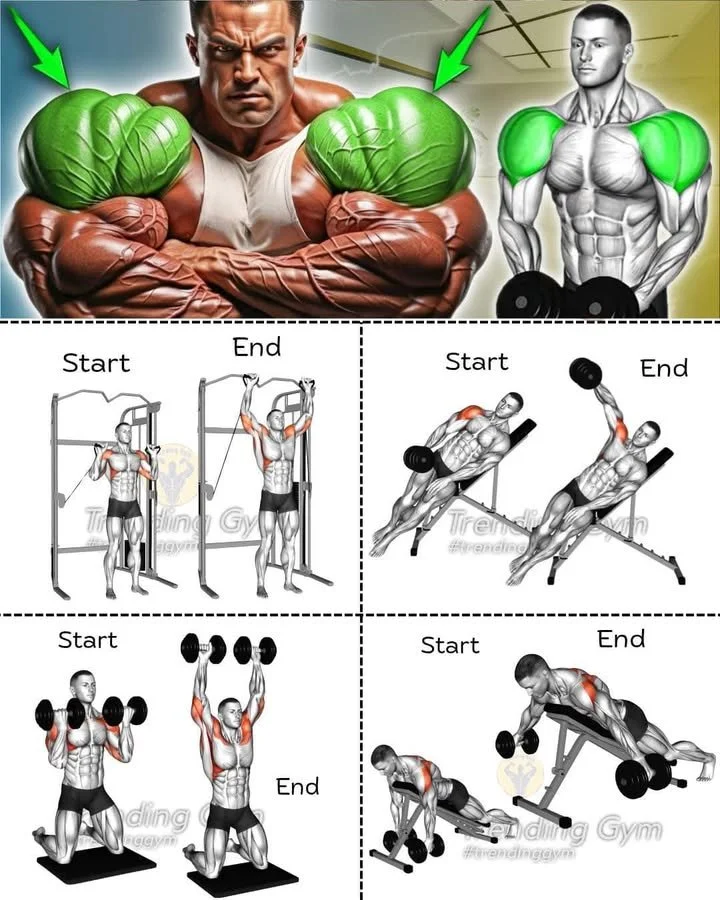
✅ Top 4 Best Shoulders Deltoid Exercises – Shoulder Day 1 Cable Standing Shoulder Press 2 Dumbbells Lateral Raises on Incline Bench 3 Dumbbells Front Raises 4 Dumbbells Rear Delts Raises on Inclin…

Top 4 Best Shoulder Deltoid Exercises for an Effective Shoulder Day

Shoulder workouts are essential for building upper body strength and achieving a balanced physique. The deltoid muscles, which form the rounded shape of the shoulders, can often be overlooked. However, incorporating targeted exercises can lead to significant gains in size and strength. In this article, we’ll explore the top four deltoid exercises to maximize your shoulder day routine.

1. Cable Standing Shoulder Press

The Cable Standing Shoulder Press is a fantastic exercise for building strength and stability in the deltoids. Using a cable machine helps to maintain constant tension throughout the movement, which is crucial for muscle growth.

How to Perform:

  • Stand facing away from the cable machine with the cables set to the lowest position.
  • Grip the handles with both hands at shoulder height, palms facing forward.
  • Engage your core, and press the handles overhead while keeping your elbows slightly in front of you.
  • Lower back down to shoulder height with control.

Repetitions: Aim for 3-4 sets of 8-12 reps.

2. Dumbbell Lateral Raises on Incline Bench

Performing Dumbbell Lateral Raises on an incline bench takes this classic shoulder exercise to the next level by isolating the lateral deltoid and minimizing cheating through momentum.

How to Perform:

  • Set an incline bench to about 30 degrees and lie on your side with a dumbbell in your top hand.
  • Start with the dumbbell at your side, arm fully extended.
  • Raise the dumbbell horizontally until it reaches shoulder height, keeping a slight bend in your elbow.
  • Lower the dumbbell back down slowly to the starting position.

Repetitions: Aim for 3-4 sets of 10-15 reps per arm.

3. Dumbbell Front Raises

Dumbbell Front Raises effectively target the anterior deltoids and improve shoulder definition. This exercise is straightforward but requires proper form to avoid injury.

How to Perform:

  • Stand with your feet shoulder-width apart, holding a dumbbell in each hand at your thighs.
  • Engage your core and raise both dumbbells simultaneously in front of you until they reach shoulder height.
  • Keep your arms straight but not locked, and control the weights as you lower them back to your thighs.

Repetitions: Aim for 3-4 sets of 10-15 reps.

4. Dumbbell Rear Delts Raises on Incline Bench

To achieve well-rounded shoulder development, it’s essential to target the rear deltoids. The Dumbbell Rear Delts Raises on an incline bench emphasizes the posterior deltoid and helps improve posture.

How to Perform:

  • Set an incline bench to about 30 degrees and lay face down with a dumbbell in each hand, arms hanging straight down.
  • Keeping a slight bend in your elbows, raise the dumbbells outward in a wide arc until they are parallel to the ground.
  • Squeeze the shoulder blades together at the top, then lower the weights back to the starting position.

Repetitions: Aim for 3-4 sets of 10-15 reps.

Conclusion

Incorporating these top four shoulder deltoid exercises into your shoulder day routine will help you build strength, improve muscle definition, and enhance your overall performance in the gym. Remember to focus on form and control to maximize your results and prevent injury. Happy lifting!

✅ Top 4 Best Shoulders Deltoid Exercises – Shoulder Day 1 Cable Standing Shoulder Press 2 Dumbbells Lateral Raises on Incline Bench 3 Dumbbells Front Raises 4 Dumbbells Rear Delts Raises on Inclin… Read More »

, , , ,
Three effective abs workouts for home fitness to strengthen your core.

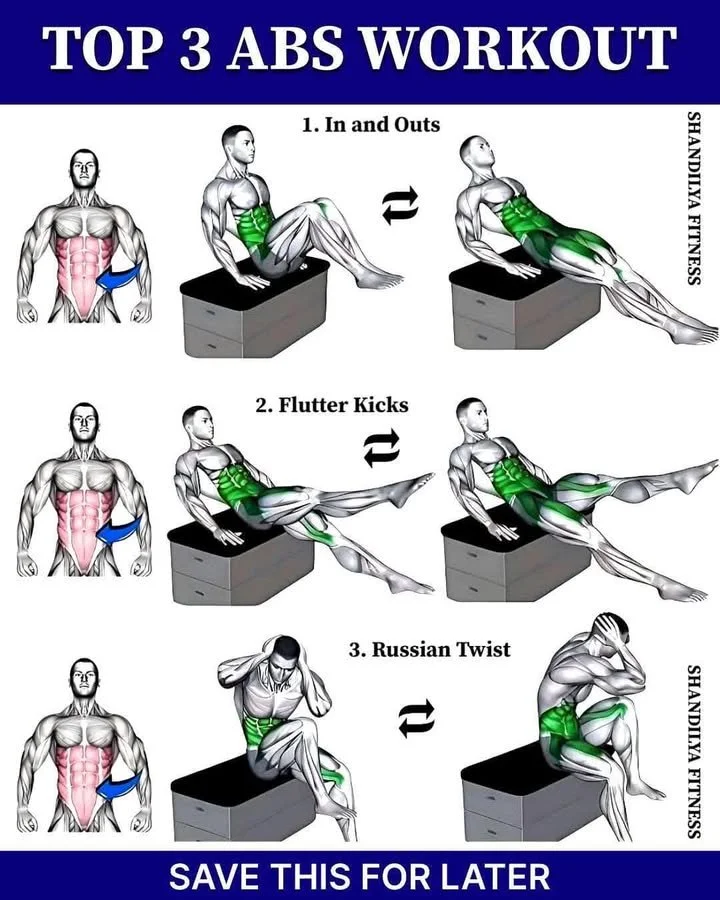
🔸Top 3 Abs Workout ✅ Do these three at home and see the difference. #absworkout #abs #homeworkout #healthyliving #workout #viralpost

Transform Your Core: Top 3 Abs Workouts You Can Do at Home

In the journey towards achieving a strong and toned midsection, consistency is key. With just a few dedicated moves, you can effectively target your abdominal muscles from the comfort of your home. Whether you’re a fitness novice or a seasoned athlete, incorporating these three essential abs workouts into your routine will help you see the difference in no time. Ready to get started? Let’s dive in!

1. Plank

The plank is a fundamental exercise that engages your entire core. It’s excellent for building strength and endurance without requiring any special equipment.

How to Do It:

  1. Begin on your hands and knees, then extend your legs back until your body forms a straight line from head to heels.
  2. Engage your core by pulling your belly button towards your spine.
  3. Hold this position for 30 seconds to a minute, ensuring your hips don’t sag or lift too high.

Tips:

  • Keep your neck neutral by looking at a spot on the floor.
  • If full planks are too challenging, drop to your knees for a modified version.

2. Bicycle Crunches

Bicycle crunches are an effective way to target both your upper and lower abdominal muscles while promoting mobility in your hips.

How to Do It:

  1. Lie flat on your back and place your hands behind your head.
  2. Bring your knees up to a 90-degree angle.
  3. Lift your shoulder blades off the ground and twist your torso, bringing your right elbow towards your left knee while straightening your right leg.
  4. Alternate sides in a pedaling motion.

Tips:

  • Move slowly and deliberately for maximum engagement of your core.
  • Focus on bringing your elbow to your knee, rather than just moving your knee to your elbow.

3. Leg Raises

Leg raises specifically target the lower abdominal area, which can be more challenging to engage. They are a fantastic addition to any abs workout routine.

How to Do It:

  1. Lie on your back with your legs straight and arms at your sides or underneath your lower back for support.
  2. Keeping your legs straight, lift them to a 90-degree angle.
  3. Lower your legs back down without letting them touch the floor, then repeat.

Tips:

  • Keep your core engaged throughout the movement to avoid straining your lower back.
  • If necessary, bend your knees slightly to modify the exercise.

Conclusion

Incorporating these three workouts into your fitness regimen can significantly contribute to a stronger, more defined core. Remember, consistency is crucial, so aim to include these exercises at least two to three times a week. Over time, you will not only notice a difference in your abs but also in your overall posture and strength.

Join the Challenge!

Are you ready to take your fitness to the next level? Share your journey using the hashtags: #absworkout #abs #homeworkout #healthyliving #workout and inspire others to join you on the path to a healthier lifestyle!

Let’s get to work and sculpt those abs!

🔸Top 3 Abs Workout ✅ Do these three at home and see the difference. #absworkout #abs #homeworkout #healthyliving #workout #viralpost Read More »

, , , ,
How to Build Bigger Glutes

How to Build Bigger Glutes: A Comprehensive Guide

let’s fined out is it bigger Glutes

Achieving well-defined and bigger glutes is a common fitness goal for many individuals. A structured workout routine that focuses on the right exercises can help in strengthening and enlarging this muscle group effectively. Below, we will explore some key exercises you can incorporate into your fitness regime for massive glute gains.

How to Build Bigger Glutes

1. Reverse Hyper Extensions

Reverse hyperextensions are an excellent exercise for targeting the gluteus maximus while also engaging the lower back and hamstrings. This movement mimics the natural hip extension pattern, which is crucial for glute growth.

How to Perform:

  • Position yourself on the reverse hyperextension machine with your hips at the edge.
  • Grab the handles securely.
  • Allow your legs to hang off the edge, keeping your feet pointed and slightly together.
  • Engage your core and lift your legs in a controlled motion until they are parallel to the ground.
  • Slowly lower your legs back to the starting position.

Sets and Reps: Perform 3 sets of 12-15 reps.

2. Romanian Deadlift

The Romanian deadlift is a fantastic compound movement focusing on the posterior chain, particularly the glutes and hamstrings. This exercise not only builds strength but also improves flexibility in the hips.

How to Perform:

  • Stand with feet shoulder-width apart, holding a barbell with both hands in front of your thighs.
  • Keeping your knees slightly bent, hinge at the hips and lower the barbell along your legs, maintaining a straight back.
  • Go as low as your flexibility allows, ideally stopping when you feel a stretch in your hamstrings.
  • Engage your glutes to return to the starting position while keeping your back straight.

Sets and Reps: Complete 3 sets of 12-15 reps.

3. Back Extensions

How to Build Bigger Glutes

Back extensions, often performed on a hyperextension bench, are excellent for strengthening the lower back while also engaging the glutes. This exercise emphasizes hip extension and can contribute to building stronger glute muscles.

How to Perform:

  • Position yourself on the back extension machine, ensuring your hips are snug against the pad.
  • Cross your arms over your chest or place your hands behind your head.
  • Lower your upper body towards the ground while maintaining a straight spine.
  • Engage your glutes and lift your torso back to a neutral position.

Sets and Reps: Aim for 3 sets of 12-15 reps.

4. Wall Squats

Wall squats are a low-impact exercise that can help promote proper squat form while effectively targeting the glute muscles. This is an excellent movement for building endurance and strength in the glutes.

How to Perform:

  • Stand with your back against a wall, feet shoulder-width apart, and about 2 feet away from the wall.
  • Slide your back down the wall until your thighs are parallel to the ground, ensuring your knees do not go past your toes.
  • Hold this position while engaging your core and glutes.
  • Slowly push through your heels to stand back up against the wall.

Sets and Reps: Perform 3 sets of 12-15 reps.

Conclusion

Building bigger glutes requires a combination of effective exercises, proper form, and consistency. By incorporating reverse hyperextensions, Romanian deadlifts, back extensions, and wall squats into your routine, you will start seeing improvements in your strength and glute development. Always remember to warm up before your workout and listen to your body to prevent injuries. Happy lifting!

How to Build Bigger Glutes: A Comprehensive Guide Read More »

, , , ,
Scroll to Top