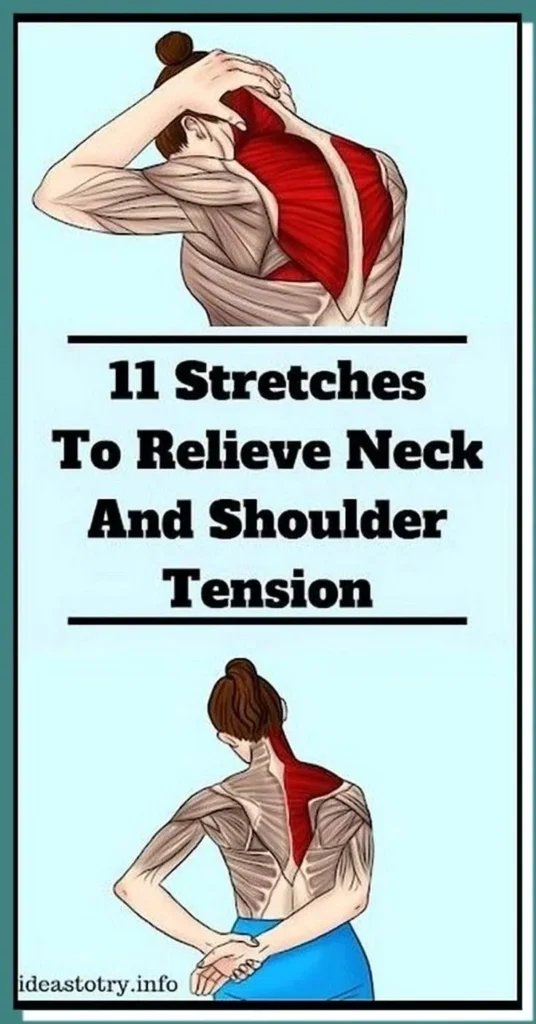

15 Stretches to Relieve a Stiff Neck, Tight Shoulders, and Upper Back Pain
15 Stretches to Relieve a Stiff Neck, Tight Shoulders, and Upper Back Pain
A stiff neck, tight shoulders, and upper back pain are common complaints from long hours at a desk, poor posture, or stress. Regular, gentle stretching can reduce tension, improve mobility, and lower the chance of recurring discomfort. Pair these stretches with short movement breaks, good ergonomics, and proper recovery — even small dietary supports can help; for example, learn how to increase your protein intake to support tissue repair.
How to use this routine
- Perform these stretches slowly and without bouncing.
- Hold each static stretch 20–45 seconds, repeat 2–3 times per side when relevant.
- Breathe steadily (inhale through the nose, exhale through the mouth) and stop if you feel sharp pain.
- Aim to do this sequence once or twice daily when symptoms are present, and as part of a regular mobility routine.
Warm-up (2–4 minutes)
- Shoulder circles: 10 slow forward, 10 backward.
- Gentle chin tucks and head turns to get the neck moving.
Warming up increases blood flow and makes stretches safer and more effective.
The 15 stretches
- Chin Tuck (Neck Retraction)
- How: Sit/stand upright. Gently draw the chin straight back (not down), creating a “double chin” feeling. Keep eyes level.
- Hold: 10–20 seconds. Repeat 5 times.
- Benefits: Improves forward-head posture and reduces neck strain.
- Levator Scapulae Stretch
- How: Sit upright. Rotate your head 45° away, then tilt your chin toward your chest. Use the hand on the same side to gently deepen the stretch.
- Hold: 20–30 seconds per side.
- Tip: Keep shoulders relaxed and breathe into the stretch.
- Upper Trapezius Stretch
- How: Sit tall. Drop one ear toward the shoulder and use the hand on that side to add gentle pressure at the temple.
- Hold: 20–30 seconds per side.
- Caution: Avoid shrugging the shoulder toward the ear.
- Scalene Stretch
- How: Turn your head slightly away and tilt it back to the opposite side to feel the front/side of the neck stretch.
- Hold: 20–30 seconds per side.
- Use: Helps with tension that can refer pain into the shoulders and arms.
- Levator and Rhomboid Release (Self-massage)
- How: Reach across with opposite hand and press between the shoulder blade and spine; hold and breathe, or use a massage ball against a wall.
- Hold: 20–30 seconds on tender spots.
- Benefit: Releases common trigger points in the upper back.
- Doorway Pec Stretch
- How: Place forearms on either side of a doorway at shoulder height and gently lean forward.
- Hold: 20–45 seconds.
- Why: Opens the chest, counteracting slumped posture that tightens the neck and shoulders.
- Cross-Body Shoulder Stretch
- How: Bring one arm across the chest and use the other arm to hug it in.
- Hold: 20–30 seconds per side.
- Great for: Posterior shoulder tightness and shoulder blade mobility.
- Cow-Face Arms (Gomukhasana arms)
- How: Reach one hand over the shoulder and the other up the back, trying to clasp fingers. Use a strap if needed.
- Hold: 20–30 seconds per side.
- Improves: Shoulder external/internal rotation balance.
- Cat-Cow (Spinal Mobilization)
- How: On hands and knees, alternate arching the mid/upper back (cat) and dropping the belly with lifted chest (cow).
- Reps: 8–12 slow cycles.
- Benefit: Mobilizes the thoracic spine to reduce upper back stiffness.
- Thread-the-Needle (Thoracic Rotation)
- How: On hands and knees, slide one arm under the opposite arm, lowering the shoulder and head, then rotate the chest open toward the ceiling.
- Reps: 6–8 per side.
- This improves: Upper back rotation and shoulder mobility.
- Seated Thoracic Extension (Over a Chair)
- How: Sit on the edge of a chair with hands behind your head. Lean back over the top of the chair (beneath shoulder blades) to extend the thoracic spine.
- Hold: 10–20 seconds, repeat 3 times.
- Helpful for: Counteracting kyphotic (rounded) posture.
- Wall Angels
- How: Stand with your back against a wall, arms in a "W." Slide arms overhead into a "Y" keeping contact with the wall as much as possible.
- Reps: 8–12 slow repetitions.
- Builds: Scapular control and shoulder mobility.
- Neck Side Bend with Arm Assist
- How: Sitting, tilt the head to one side and gently pull with the hand on that side to increase the stretch while keeping the opposite shoulder down.
- Hold: 20–30 seconds per side.
- Good for: Lateral neck tension and upper trapezius tightness.
- Sleeper Stretch (Posterior Shoulder)
- How: Lie on your side with the bottom arm bent at 90°. Use the top hand to gently press the forearm down toward the floor.
- Hold: 20–30 seconds per side.
- Note: Use caution if you have shoulder pain — don’t force range.
- Scapular Retraction Holds (Strength + Stretch)
- How: Stand/sit tall and squeeze shoulder blades down and together without shrugging. Hold for 5–10 seconds, release.
- Reps: 8–12.
- Purpose: Strengthens the muscles that support upper back posture, reducing strain on neck and shoulders. For more core and stability work that complements posture training, see this Band Twist: How to Build Core Strength guide.
Modifications and progressions
- If a stretch feels too intense, reduce range and shorten hold time.
- Use a strap, towel, or wall support where needed.
- Progress by slowly increasing hold time, repetitions, or combining stretches into a flow.
When to stop and when to see help
- Stop if you feel sharp, shooting, or worsening pain.
- See a healthcare professional if pain is severe, persistent, radiates into the arms/hands, or is accompanied by weakness, numbness, or tingling.
Quick posture and lifestyle tips
- Set an ergonomic workstation: screen at eye level, feet flat, arms supported.
- Take movement breaks every 30–60 minutes.
- Practice diaphragmatic breathing to release shoulder and neck tension.
- Strengthen mid-back and core to support better posture and prevent recurrence.
Conclusion
If you want a larger library of movements to address upper back, neck, and shoulder pain, a helpful resource is 19 Exercises for Upper Back Pain, Neck Pain, Tight Shoulders. Integrate these stretches with regular movement, ergonomic adjustments, and gradual strength work for the best long-term relief.
15 Stretches to Relieve a Stiff Neck, Tight Shoulders, and Upper Back Pain Read More »