fitness routine

Lifter performing a 15-minute warm-up hack for better gains and joint health.

Want Bigger Gains & Healthier Joints? The 15‐Minute Warm‐Up Hack Every Lifter Needs

15‑Minute Warm‑Up Hack for Bigger Gains

Want bigger lifts and joints that feel good for years? You don’t need an hour of foam rolling and mobility drills to prep—just a smart, 15‑minute warm‑up that primes your nervous system, activates stabilizers, and grooves movement patterns for safer, stronger working sets. This routine is designed for lifters of all levels and slots easily into any training day. For a quick primer on shoulder mechanics that pairs well with activation work, check out this guide to the seated dumbbell shoulder press setup.
Want Bigger Gains & Healthier Joints? The 15‐Minute Warm‐Up Hack Every Lifter Needs

Why 15 minutes is enough

  • Efficiency beats volume: a focused warm‑up that targets mobility, activation, and progressive loading gives you the nervous system readiness and joint lubrication you need without wasting energy.
  • Reduces risk and boosts performance: warming up increases synovial fluid, raises tissue temperature, and primes motor patterns so you can lift heavier with more confidence.
  • Consistency wins: a short, repeatable routine is more likely to be done before every session, which compounds into better joint health and gains over months and years.

The 15‑minute warm‑up plan (step‑by‑step)

  1. General movement (2–3 minutes)
    • Light cardio to raise heart rate: brisk walking, easy bike, or jump rope. Keep intensity low—this is about raising core and muscle temperature.
  2. Joint mobility flows (3 minutes)
    • Neck, thoracic rotations, hip circles, ankle dorsiflexion drills, and shoulder pass‑throughs using a band or broomstick. Move controlled, pain‑free, and through the ranges you’ll use for the workout.
  3. Activation & stability (4 minutes)
    • Glute bridges (2 sets x 10), banded lateral walks (1–2 sets x 10 steps each way), and scapular pull‑ups or face pulls (2 sets x 8–12). These light activations wake up muscles that stabilize your joints under load.
  4. Movement patterning (3 minutes)
    • Perform the main movement with just your bodyweight or the empty implement: bodyweight squats, push‑ups, hip hinges with a broom, or single‑arm rows. Focus on bracing, breathing, and groove.
  5. Warm‑up sets (3 minutes)
    • 2–4 progressively heavier warm‑up sets that approach working weight without hitting fatigue. For example: 50% x 5, 70% x 3, 85% x 1–2 (adjust depending on exercise and load). Keep reps crisp; this primes the nervous system for your top sets.

Programming tips

  • Match the warm‑up to the day: heavy lower‑body days get more hip and ankle work; upper‑body days get more thoracic and scapular activation.
  • Don’t overdo it: avoid fatiguing accessory work in the warm‑up—if a warm‑up set leaves you shaky on your working set, cut back.
  • Progress gradually: use the warm‑up to assess readiness—if a movement feels stiff, add an extra activation set or dynamic mobility before loading.

Joint‑friendly cues and technique reminders

  • Breathe to brace: inhale to expand the ribcage, exhale and brace the core just before the lift. This reduces shear forces and protects the spine.
  • Keep joint positions stacked: knees tracking over toes, shoulders over hips, neutral spine. Small alignment improvements reduce long‑term wear.
  • Use pain as a stop sign: transient stiffness is common; sharp or radiating pain is not. Adjust mechanics, reduce load, or consult a professional.

Nutrition and recovery note

  • Warm‑ups prepare the body; nutrition and recovery repair it. Simple steps like ensuring adequate protein and timing a small carb + protein snack before or after training help maximize repair and adaptation. For practical ideas on boosting daily protein, see how to increase your protein intake across meals and snacks.

Quick troubleshooting

  • If you feel persistently stiff in one joint despite warming up, increase mobility time for that area and consider targeted soft tissue work post‑session.
  • If warm‑up sets sap your strength, reduce volume or redistribute reps across sets to keep intensity high for working sets.
  • For long‑term joint health, alternate heavy days with lighter technique or speed sessions to reduce cumulative joint stress.
Want Bigger Gains & Healthier Joints? The 15‐Minute Warm‐Up Hack Every Lifter Needs

Conclusion

Consistent, focused warm‑ups are one of the highest‑leverage habits for better performance and joint longevity. To deepen your understanding of how to structure progressive warm‑up sets and bridge them into effective working sets, read Warm Up Sets: How to Warm Up For Your Working Sets.

Want Bigger Gains & Healthier Joints? The 15‐Minute Warm‐Up Hack Every Lifter Needs Read More »

, , , ,
9 morning habits to build muscle faster for effective fitness routines.

9 Morning Habits to Build Muscle Faster

Title: Morning Muscle Momentum

Start your day with practices that prime your body for growth. The morning is the perfect window to stack small habits that compound into faster muscle gains — from what you drink to how you warm up and what you eat. For example, beginning with a protein-focused breakfast or shake can jump-start recovery; try ideas like high-protein smoothies when you’re short on time.

9 Morning Habits to Build Muscle Faster

Why mornings matter
Morning routines set hormonal tone (testosterone and cortisol balance), energy levels, and training readiness. These nine practical habits are designed to be simple, repeatable, and science-backed so you spend less time guessing and more time building.

  1. Hydrate first thing
    Rehydrating after 7–8 hours of sleep restores blood volume and helps nutrient transport to muscles. Aim for 16–24 oz of water with a pinch of salt or a small electrolyte mix to replace sodium and potassium lost overnight.

  2. Prioritize a protein-rich breakfast
    Consuming 20–40 g of high-quality protein in the morning supplies amino acids for muscle protein synthesis and reduces muscle breakdown. Quick options: eggs, cottage cheese, Greek yogurt, or a protein shake with milk.

  3. Use strategic caffeine (if it suits you)
    A moderate dose of caffeine 30–45 minutes before training can boost strength, power output, and focus. Keep intake reasonable (100–200 mg) and avoid late-afternoon use that disrupts sleep.

  4. Move before you lift: mobility + activation
    Spend 5–10 minutes on dynamic mobility and activation drills (band pull-aparts, glute bridges, thoracic rotations). These drills reduce injury risk and make your weight work more effective.

  5. Short high-intensity bursts for conditioning
    Incorporate a brief HIIT or sprint session 1–2 times weekly to improve conditioning without compromising recovery. When paired with strength training, short sprints can support muscle retention and metabolic health.

  6. Train with compound lifts early
    Schedule compound, multi-joint lifts (squats, deadlifts, presses, rows) when you’re freshest to lift heavier and stimulate more muscle fibers. If you prefer split sessions, do the primary compound movements first in the morning.

  7. Progressively overload and track
    Small, measurable increases in load, reps, or sets over weeks create consistent growth. Keep a simple training log or app entry to record weights and notes — accountability speeds progress.

  8. Smart leg work: alternatives and balance
    If bilateral squats or Bulgarian split squats give you issues, substitute with safer or more comfortable options to maintain leg stimulus. Try split variations, step-ups, or guided-machine patterns; for more alternatives, see Bulgarian split squat alternatives to keep training effective without balance struggles.

  9. Post-workout carbs + protein and sunlight
    After training, ingest a protein-carbohydrate combo to replenish glycogen and maximize muscle repair. Also step outside for 10–15 minutes of morning sunlight for vitamin D and circadian alignment, which supports recovery and hormonal health.

Recovery, sleep, and consistency
Muscle is built between workouts. Prioritize 7–9 hours of quality sleep, manage stress with brief morning breathing or journaling, and repeat the above habits consistently — small habits every day beat sporadic extremes.

9 Morning Habits to Build Muscle Faster

Conclusion

For an expanded, actionable checklist of morning practices that accelerate hypertrophy, see this guide: Maximize Your Muscle Gain: 10 Simple Morning Habits You Need to …

9 Morning Habits to Build Muscle Faster Read More »

, , , ,

20 Minutes. One Workout. Full‐Body Transformation: The HIIT Secret Everyone’s Talking About

20‑Minute HIIT: The Full‑Body Fix

Short on time but serious about change? In just 20 minutes, one focused HIIT (High-Intensity Interval Training) session can ignite fat loss, build lean strength, and boost cardiovascular fitness — all without a gym membership. Whether you’re a beginner or returning to training after a break, this quick-session approach is designed to fit into any schedule and produce measurable results.

20 Minutes. One Workout. Full‐Body Transformation: The HIIT Secret Everyone’s Talking About

Why 20 minutes works

  • Intensity beats duration: HIIT pushes your heart rate into high zones for short bursts, which elevates calorie burn during and after exercise (the EPOC effect).
  • Full‑body engagement: Carefully chosen moves target major muscle groups so you hit strength, power, and endurance in one go.
  • Consistency over time: It’s easier to commit to short, effective workouts than hour-long sessions you dread. If you’re new to bodyweight work, consider this Calisthenics beginner guide to build foundational skills safely.

Quick science, zero fluff
HIIT causes metabolic and hormonal responses that support fat loss and muscle retention. Short high-intensity intervals followed by brief recovery spur adaptations in both aerobic and anaerobic systems. This dual demand is why many trainers call HIIT the efficient tool for full-body transformation.

20-minute full‑body HIIT — sample workout
Format: 4 rounds. Each round = 4 exercises x 40 seconds work / 20 seconds rest (including transition). Rest 60 seconds between rounds.

Round structure (choose a stable pace you can maintain):

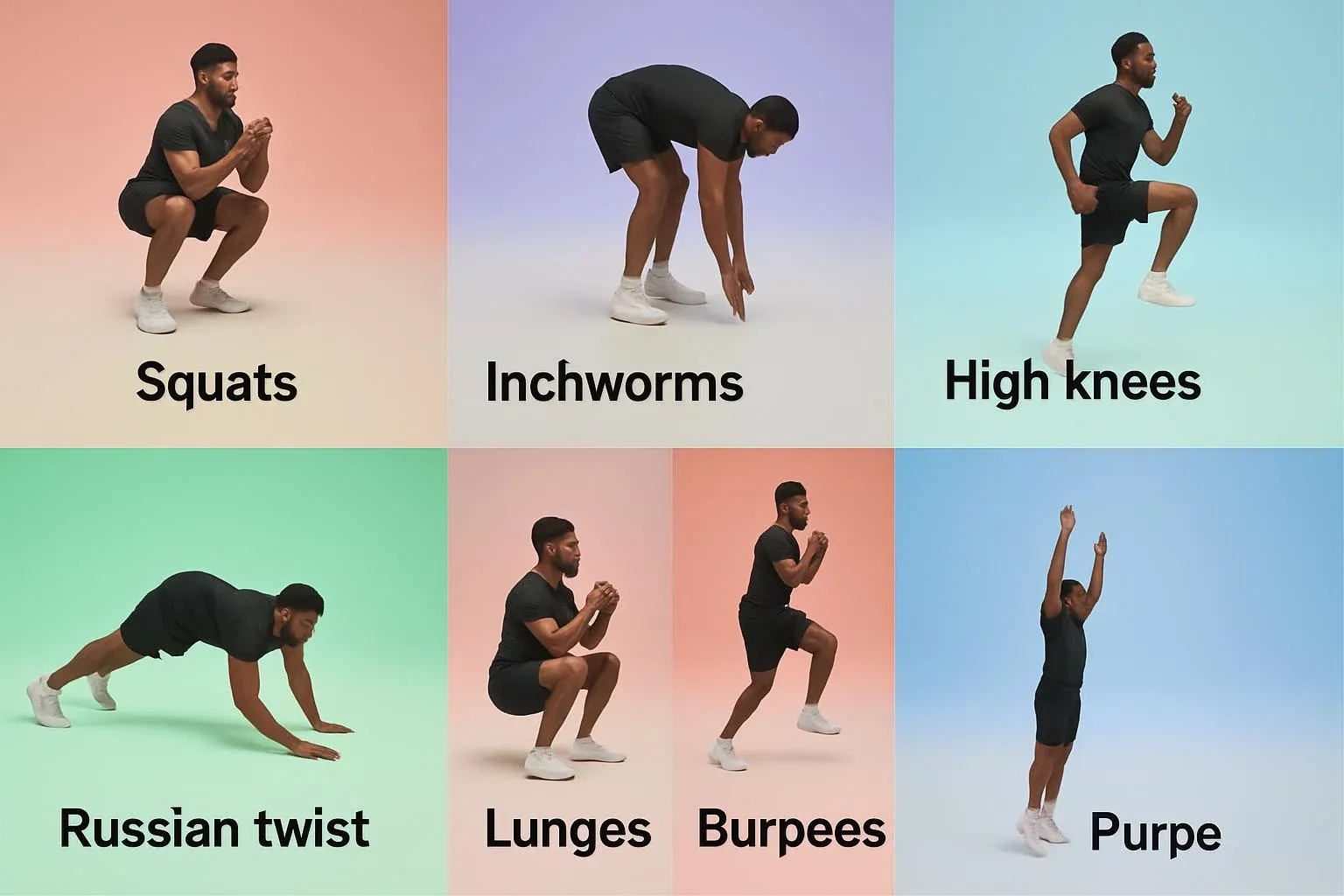
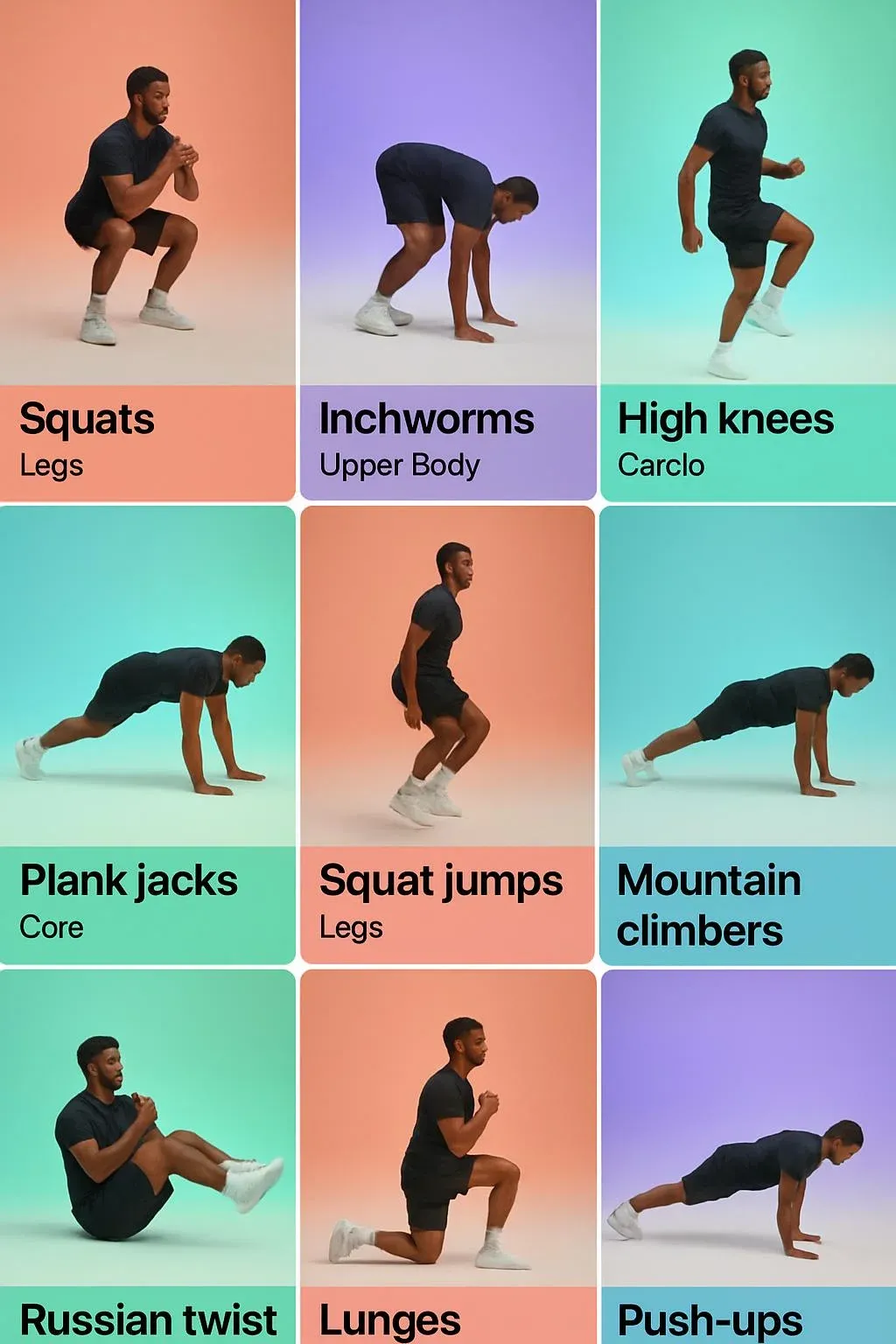
  1. Jump squats — explosive lower-body power
  2. Push‑up variations (knees, standard, or incline) — upper-body strength
  3. Mountain climbers — core and cardio blast
  4. Alternating reverse lunges (plyo or controlled) — unilateral strength/stability

Warm-up (3–4 minutes): light jog in place, leg swings, shoulder circles, a few dynamic squats and hip hinges. Cool-down (3–5 minutes): gentle walking, hamstring stretch, chest opener.

Progressions and regressions

  • If a move is too intense, drop to a lower-impact option (e.g., step-back lunges instead of jump lunges, incline push-ups instead of floor push-ups).
  • To increase challenge, lengthen work intervals to 45–50 seconds, shorten rest to 10–15 seconds, or add resistance (vest, dumbbells).
  • Track rounds or total reps to measure progress session-to-session.

Programming tips for lasting change

  • Frequency: 3–4 HIIT sessions per week paired with 1–2 strength or mobility days yields balanced adaptation.
  • Recovery: Sleep and nutrition matter as much as the workout. Prioritize protein and whole foods, and be cautious of hidden sugars or additives — see this concise food additive guide for tips on cleaner choices.
  • Consistency: Small, repeated efforts (20 minutes, 3–4x weekly) compound into visible shifts in body composition and performance.

Safety and mindset

  • Listen to your body: push hard, but avoid sharp pain or dizziness. If new to high-intensity work, start with fewer rounds and build up.
  • Form first: quality movement beats quantity. A controlled rep preserves joints and produces better long-term results.
  • Celebrate small wins: improved reps, reduced perceived exertion, or better recovery are signs of progress.

Quick weekly sample plan

  • Monday: 20‑minute HIIT (full‑body)
  • Tuesday: Active recovery (mobility, walk)
  • Wednesday: Strength focus (lower or upper)
  • Thursday: 20‑minute HIIT (alternate exercise selection)
  • Friday: Mobility or light cardio
  • Weekend: Optional outdoor activity or rest

20 Minutes. One Workout. Full‐Body Transformation: The HIIT Secret Everyone’s Talking About

Conclusion

Want a simple, effective product to support skin and overall wellness as you transform? Consider trying these Asgg Glutathione Collagen Glow Gummies Apple Cider Vinegar as a supplement option to complement consistent training and nutrition: Asgg Glutathione Collagen Glow Gummies Apple Cider Vinegar.

Putting the plan into practice — twenty focused minutes, three to four times weekly — is all you need to begin a full‑body transformation.

20 Minutes. One Workout. Full‐Body Transformation: The HIIT Secret Everyone’s Talking About Read More »

, , , ,
Person exercising at 6 AM for improved health and fitness benefits.

What happens to your body when you exercise at 6 AM for 30 days

Dawn Gains: 30 Days of 6 AM Workouts and What They Do to Your Body

Starting a 6 AM workout habit for 30 consecutive days is a small time shift that often yields outsized changes. In the first week you’ll feel immediate shifts in energy and mood; by day 30 those changes typically become measurable improvements in sleep, body composition, and mental clarity. If you’re planning what to do each morning, consider pairing short strength sessions with cardio and recovery — many people find guided full-body routines help them stay consistent.

What happens to your body when you exercise at 6 AM for 30 days

What happens in the first week

  • Sleep inertia eases: Waking earlier is rough at first, but morning light exposure and consistent timing reduce grogginess across days 3–7.
  • Acute energy and focus boost: A 20–45 minute session increases blood flow and endorphins, improving attention for several hours.
  • Appetite shifts: Early workouts often suppress immediate hunger, which can change when and what you eat during the day.

Tip: keep sessions short and manageable at the start (20–30 minutes) to build the habit without burnout.

Physiological adaptations by week two to four

  • Improved cardiovascular fitness: Regular morning cardio or HIIT raises VO2 capacity and lowers resting heart rate.
  • Better metabolic control: Morning exercise helps improve insulin sensitivity and can slightly increase resting metabolic rate, aiding fat loss when paired with nutrition.
  • Muscle and strength gains: With consistent resistance training, neuromuscular adaptations and early hypertrophy begin within 2–4 weeks.
  • Hormonal regulation: Cortisol naturally spikes in the morning; exercising at 6 AM can help align cortisol release with activity, potentially improving stress handling through the day.

Practical note: Progressive overload still matters. Small weekly increases in intensity or volume drive strength and muscle improvements.

Sleep and circadian effects

  • More regular sleep-wake cycle: Committing to a 6 AM start usually forces a consistent bedtime, which strengthens circadian rhythm and sleep quality.
  • Melatonin timing: Better evening routines help melatonin onset and deeper sleep stages, improving recovery.
  • Caveat: Overtraining or late-day stimulants can counteract sleep benefits, so monitor total weekly load.

Body composition and weight trends

  • Fat loss potential: Morning workouts combined with a modest calorie deficit can accelerate fat loss because exercise increases daily energy expenditure and improves metabolic flexibility.
  • Muscle retention/gain: Prioritize protein intake and resistance work—early workouts can be effective for hypertrophy if nutrition and recovery are sufficient.

If you need quick snack ideas before early workouts, a light carb + protein option works best — see suggestions for the best pre-workout snacks to power your morning routine.

Mental and cognitive benefits

  • Enhanced mood and resilience: Regular morning exercise raises baseline mood and reduces perceived stress.
  • Better productivity: Many people report improved executive function and faster start to the workday after consistent early workouts.
  • Habit stacking advantage: Exercising first thing makes adding other healthy habits (water, nutrient-dense breakfast, planning) easier.

Sample 6 AM, 30-day morning routine

  • 5:30 AM — gentle hydration (250–350 ml water), light mobility
  • 5:45 AM — quick snack if needed (banana + a spoonful of nut butter)
  • 6:00–6:30 AM — workout (alternate strength days with cardio/HIIT)
  • 6:30–6:40 AM — cool-down, stretching, 3–5 minutes deep breathing
  • 6:45 AM — protein-focused breakfast and plan the day

Adjust volume based on energy and schedule; consistency beats perfection.

Tracking progress and common pitfalls

  • Trackable measures: Resting heart rate, sleep duration/quality, body measurements, workout load, and energy ratings give a clear picture of changes across 30 days.
  • Avoid overreaching: Starting too hard leads to fatigue and missed days. Build volume gradually.
  • Nutrition and hydration: Early workouts require attention to post-workout protein and electrolytes to support recovery.

What happens to your body when you exercise at 6 AM for 30 days

Conclusion

After 30 days of 6 AM workouts you’ll likely notice clearer mornings, improved sleep timing, better mood, and measurable fitness gains. To keep that momentum, structure your day around productive blocks and realistic routines — a helpful guide is available at The Most Productive Way to Schedule Your Day.

What happens to your body when you exercise at 6 AM for 30 days Read More »

, , , ,
A person engaging in a high-intensity interval training workout for full-body transformation.

20 Minutes. One Workout. Full‐Body Transformation: The HIIT Secret Everyone’s Talking About

Transform in 20 Minutes

HIIT (High-Intensity Interval Training) is the fitness trend people swear by for good reason — it’s efficient, intense, and can deliver noticeable full-body results in a fraction of the time traditional workouts demand. In just one 20-minute session, you can torch calories, boost metabolism for hours afterward, and build strength and endurance when workouts are planned intelligently. If you’re curious how such a short routine can be this effective — and how to fit it into a busy life — read on. Newcomers to bodyweight training will find these principles especially useful.

20 Minutes. One Workout. Full‐Body Transformation: The HIIT Secret Everyone’s Talking About

Why 20 Minutes Works

  • Intensity over duration: Short bursts of near-max effort raise heart rate and recruit fast-twitch muscle fibers, stimulating both aerobic and anaerobic systems.
  • EPOC effect: After intense intervals your body consumes more oxygen post-workout, increasing calorie burn (excess post-exercise oxygen consumption).
  • Consistency: A 20-minute time commitment is easy to schedule daily, increasing adherence and cumulative gains.

The Science in Simple Terms
HIIT alternates high-effort work with short recovery. Effective progress relies on:

  • Progressive overload: gradually increase reps, intensity, or shorten rest.
  • Balanced movements: combine push, pull, hinge, squat, and core patterns to target the whole body.
  • Adequate recovery: sleep, nutrition, and active rest days prevent overtraining.

20-Minute Full-Body HIIT — Sample Workout (No Equipment)
Format: 40 seconds work / 20 seconds rest. Repeat circuit twice (total ~20 minutes including quick warm-up).

  1. Jump squats — explosive lower-body power.
  2. Push-up variations — standard or knees for scaling.
  3. Reverse lunges (alternating) — unilateral strength and stability.
  4. Mountain climbers — core and cardio.
  5. Plank-to-downward-dog — core and mobility.
  6. Burpees — full-body metabolic finisher.

Warm-up (3–4 minutes): light jogging in place, arm circles, hip swings.
Cool-down (3–4 minutes): gentle stretching, deep breathing.

Scaling & Progressions

  • Beginner: 30s work / 30s rest, reduce impact (step-back lunges, incline push-ups).
  • Intermediate: 40/20 as above, increase sets or add weight.
  • Advanced: 45/15 or add plyometric/weighted variations.

Programming Tips

  • Frequency: 3–5 sessions/week depending on goals and recovery.
  • Pair with strength days if focusing on maximal strength — make HIIT the metabolic day.
  • Track performance: record rounds, reps, and RPE (rate of perceived exertion).

Nutrition, Recovery & Common Mistakes
Fuel intelligently: prioritize protein, whole-food carbs around workouts, and hydration. Avoid the temptation to treat HIIT as a license for poor diet — nutrition determines how quickly you’ll see changes. For more on hidden diet risks and ingredients to watch out for, consider this analysis of common additives to be aware of: the three food additives you should be worried about.

Common mistakes:

  • Doing HIIT daily without rest (increases injury risk).
  • Prioritizing duration instead of intensity.
  • Neglecting mobility and proper form — speed must not kill technique.

Practical Weekly Plan (Example)

  • Monday: 20-min HIIT (full-body)
  • Tuesday: Strength training (upper focus)
  • Wednesday: Active recovery (yoga/walk)
  • Thursday: 20-min HIIT (lower focus)
  • Friday: Strength training (lower focus)
  • Saturday: Light HIIT or sport
  • Sunday: Rest

20 Minutes. One Workout. Full‐Body Transformation: The HIIT Secret Everyone’s Talking About

Conclusion

Short, well-structured HIIT sessions can produce outsized results when paired with smart nutrition and recovery. For those exploring supplements and wellness options that complement a fitness routine, consider resources like Asgg Glutathione Collagen Glow Gummies Apple Cider Vinegar for additional support — always consult a healthcare professional before adding supplements.

20 Minutes. One Workout. Full‐Body Transformation: The HIIT Secret Everyone’s Talking About Read More »

, , , ,
Person performing a Lat Pulldown exercise in a gym setting

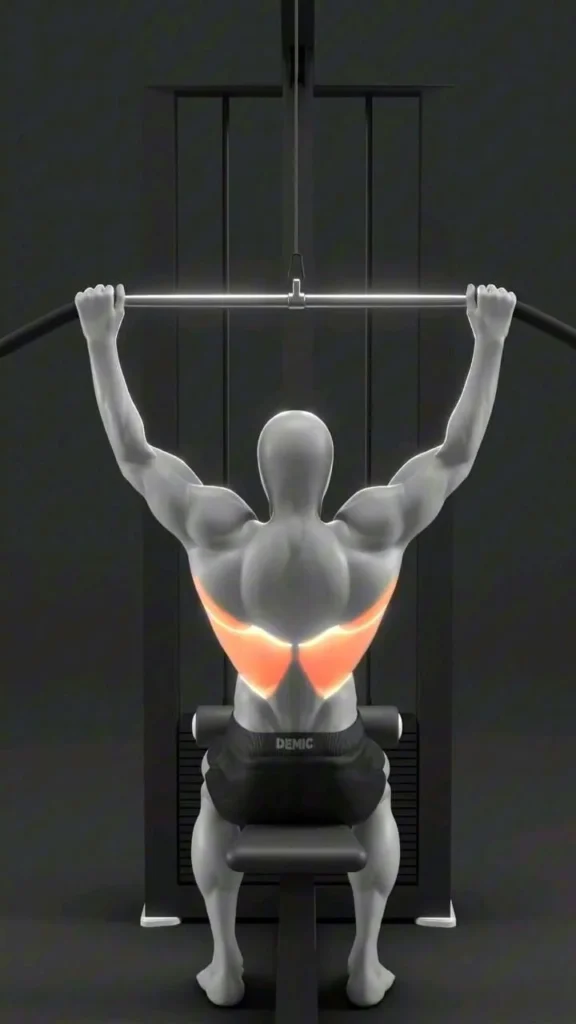
Lat Pulldown Workout

Lat Pulldown Workout: Build a Strong, Wide Back

The lat pulldown is a staple exercise for developing the latissimus dorsi (lats), improving posture, and increasing pulling strength for rows and pull-ups. Whether you’re a beginner or an experienced lifter, a well-structured lat pulldown workout can add width to your back and balance upper-body development. If you train full-body routines, lat pulldowns pair well with compound movements—see a suggested pairing in this 10 Best Full-Body Workouts guide.

Why the Lat Pulldown Matters

  • Targets the lats, teres major, and middle back muscles, helping create the coveted “V” taper.
  • Assists in improving posture by strengthening scapular depressors and retractors.
  • Transfers to functional and sport-specific movements like climbing, rowing, and pull-ups.
  • Scalable for beginners through advanced lifters using different grips and tempos.

Proper Technique: Step-by-Step

  1. Setup: Sit with knees secured under the pad, chest tall, and feet flat. Choose a grip width appropriate to the variation you’re performing.
  2. Grip and alignment: Hold the bar with a grip that’s slightly wider than shoulder-width for the classic wide pulldown. Keep shoulder blades pulled down and back before initiating the pull.
  3. The pull: Pull the bar down in a controlled arc to the upper chest (or slightly below chin for some variations). Lead with the elbows, not the hands, and maintain a slight backward lean from the hips—avoid excessive torso swinging.
  4. Lowering phase: Slowly return the bar to the starting position with control, allowing a full stretch in the lats without letting the weight stack slam.
  5. Breathing: Exhale while pulling down, inhale while returning to start.

Key cues: “Elbows to ribs,” “Chest up,” and “Slow on the negative.”

Variations to Target Different Angles

  • Wide-Grip Lat Pulldown: Emphasizes outer lats and width.
  • Close-Grip/Neutral-Grip Pulldown: Hits lower lats and biceps more.
  • Reverse (Underhand) Grip: Increases biceps involvement and can help lifters with elbow mobility.
  • Single-Arm Pulldown: Corrects left-right strength imbalances and improves scapular control.
  • Behind-the-Neck Pulldown: Not generally recommended due to shoulder stress—use caution and only if you have excellent mobility and supervision.

Programming: Sets, Reps, and Progression

  • Beginners: 3 sets of 8–12 reps with moderate weight and strict form.
  • Intermediate: 3–5 sets of 6–10 reps for strength, or 8–12 for hypertrophy. Add tempo variations (e.g., 2-1-3) to increase time under tension.
  • Advanced: Incorporate drop sets, supersets (e.g., with rows or face pulls), and single-arm work to break plateaus.

Lat pulldowns fit well into full-body or upper-body days. For busy schedules, you can include a focused lat pulldown superset in a time-efficient routine—see a practical template in this 20-Minute Full-Body Workout for Busy Schedules article.

Sample workouts:

  • Hypertrophy session: 4 sets x 10 reps (wide grip), superset with 3 sets x 12 single-arm cable rows.
  • Strength session: 5 sets x 5 reps (close grip), rest 2–3 minutes between sets.
  • Volume day: 3 sets x 8 (wide), 3 sets x 10 (reverse grip), finish with 2 drop sets.

Common Mistakes and Fixes

  • Using momentum: Reduce weight and focus on elbow drive to stay strict.
  • Pulling behind the neck: This can compromise shoulder health—pull to the chest instead.
  • Shrugging shoulders: Pre-activate scapular depression before each rep to shift tension to the lats.
  • Not achieving full range of motion: Allow a controlled stretch at the top and a full contraction at the bottom.

Accessory Exercises and Progressions

  • Assisted or banded pull-ups to transfer vertical pulling strength.
  • Bent-over rows and single-arm dumbbell rows to build mid-back thickness.
  • Face pulls and band pull-aparts to strengthen rear delts and improve shoulder stability.
  • Gradually reduce machine assistance or add weight to the stack while maintaining strict form for progression.

Modifications and Who Should Be Cautious

  • If you have shoulder impingement or limited overhead mobility, use neutral-grip handles or perform single-arm pulldowns to reduce strain.
  • Those with lower-back issues should avoid excessive leaning—focus on an upright torso and core bracing.
  • Always prioritize pain-free movement; stop if you feel sharp joint pain.

Safety Tips

  • Warm up with light rows and band pull-aparts to prime the scapular muscles.
  • Control the eccentric phase—don’t let the weight slam back up.
  • Use a full range of motion tailored to your mobility and training goals.
  • Keep a steady cadence and track progressive overload (weight, reps, or time under tension).

Conclusion

For a comprehensive how-to, variations, and safety considerations on the exercise, consult this detailed guide: Lat Pulldowns: Techniques, Benefits, Variations.

Lat Pulldown Workout Read More »

, , , ,
Woman performing a chest fly exercise with dumbbells for strength training

Chest Fly Workout

Chest Fly Workout: Build a Fuller, Stronger Chest

The chest fly is a staple isolation move that stretches and contracts the pectoral muscles in a way pressing movements can’t fully replicate. Whether you’re aiming for better chest shape, improved muscle activation, or finishing off a heavy pressing day, flys are an essential tool. If you want a variation that targets the upper pecs with a rotational cue, check out this dumbbell chest workout with twist incline fly for ideas on sets and rep ranges that emphasize the upper fibers.

This article explains why flys work, how to perform them safely, which variations to use, and sample programming to add them to your routine.

Why Flys Work

  • Isolation for the chest: Fly movements put the pectoralis major under long-axis tension, emphasizing stretch and peak contraction.
  • Complementary to presses: Presses (bench, incline, dips) are compound and allow heavy loading. Flys let you focus on range of motion and mind-muscle connection without heavy triceps involvement.
  • Hypertrophy benefits: Moderate loads with controlled tempo and full range increase time under tension, which is effective for muscle growth.

Variations and When to Use Them

  • Dumbbell Flat Fly: Classic, best for mid-chest development and full pec stretch.
  • Incline Dumbbell Fly: Targets upper chest. Use moderate incline (15–30°) to shift emphasis upward.
  • Decline Fly: Emphasizes lower chest fibers.
  • Cable Fly (standing or lying): Keeps constant tension throughout the range; excellent for finishing sets and peak contraction.
  • Pec Deck Machine: Great for beginners or for isolating without stabilizer fatigue.
  • Single-arm and alternating flys: Useful for correcting imbalances and for stricter control.

For a concise plan that blends fly variations into a complete chest routine, the best chest workout routine overview offers a straightforward 4-exercise scheme you can adapt.

Proper Technique (Dumbbell Fly Example)

  1. Setup: Lie flat on a bench with a dumbbell in each hand, palms facing each other. Feet planted, back neutral.
  2. Start position: Bring weights together above chest with a slight bend in elbows. This bend should stay consistent.
  3. Descent: Open arms wide in a controlled arc, feeling a stretch across the chest. Go until your elbows are roughly in line with the bench (or a comfortable stretch), not necessarily until your upper arm is parallel with the floor if shoulder comfort is an issue.
  4. Ascent: Reverse the arc by squeezing the chest and bringing dumbbells together above chest, maintaining the elbow angle.
  5. Breathing: Inhale on the descent; exhale on the squeeze upward.
  6. Tempo: Typical hypertrophy tempo is 2–4 seconds down, 1–2 second pause (optional), then 1–2 seconds up.

Common mistakes:

  • Using too heavy a weight and turning the fly into a press.
  • Dropping elbows too low (risking shoulder strain).
  • Excessive speed, losing muscle tension.

Programming and Sample Workouts

Guidelines:

  • Reps: 8–15 for hypertrophy; 12–20 for a higher-rep finisher.
  • Sets: 3–5 sets depending on how much chest volume you’re accumulating that session.
  • Placement: Use flys after heavy compound presses or as a finisher at the end of a chest workout.
  • Progression: Increase time under tension, range of motion, or add a few reps before increasing weight.

Sample Routines:

  • Mass-focused chest day

    • Barbell bench press: 4 sets × 6–8 reps
    • Incline dumbbell press: 3 sets × 8–10 reps
    • Dumbbell flat fly: 3–4 sets × 10–12 reps
    • Cable crossovers (high to low): 3 sets × 12–15 reps
  • Chest-finisher circuit

    • Incline dumbbell fly (moderate weight) 12 reps
    • Flat bench push-ups 15 reps
    • Cable fly (slow negatives) 12–15 reps
    • Rest 60–90 seconds and repeat for 3 rounds

Safety, Mobility, and Progressions

  • Warm up shoulders and scapulae with band pull-aparts and rotator cuff activation.
  • Limit the range if you feel sharp anterior shoulder pain—maintain a safe, comfortable stretch.
  • Mix cables and dumbbells to manage load and constant tension differences.
  • Progress by increasing reps, adding a drop set, slowing eccentric tempo, or slightly increasing weight while preserving form.

Conclusion

For technique demonstrations and extra tips on the dumbbell fly movement, see this helpful Dumbbell Flys: Video Exercise Guide & Tips.

Chest Fly Workout Read More »

, , , ,
Person performing an abs workout routine for core strength and definition.

Abs Workout

Abs Workout: Build a Strong, Functional Core

A well-rounded abs workout does more than create a visible six-pack — it builds a stable, resilient core that improves posture, reduces injury risk, and enhances athletic performance. Whether you train at home or in a gym, consistent progress comes from balanced programming, solid technique, and gradual overload. If you want a quick at-home starter routine, see this Top 3 Abs Workout at Home for simple options you can do with minimal equipment.

Why Train the Abs (Beyond Aesthetics)

The abdominal muscles are central to nearly every movement pattern:

  • They stabilize the spine during lifting and bending.
  • They transfer force between upper and lower body (important for athletics).
  • They assist breathing mechanics and pelvic alignment.

Training the abs with functional, multi-plane exercises improves real-world strength more than endless isolated crunches.

Core Anatomy — What to Target

Focus on these major players:

  • Rectus abdominis: responsible for trunk flexion (the “six-pack”).
  • External and internal obliques: rotate and side-bend the torso; key for anti-rotation strength.
  • Transverse abdominis: deep stabilizer that compresses the abdomen and protects the lumbar spine.
  • Hip flexors: contribute to leg-raise movements but can dominate if overused — balance is crucial.

Understanding each muscle’s role helps you pick exercises that develop both stability and movement.

Designing an Effective Abs Workout

Follow these programming principles:

  • Frequency: 2–4 sessions per week depending on overall training volume.
  • Volume: 8–20 working sets per week for the abs spread across sessions.
  • Intensity: prioritize quality of contraction and progressive challenge (add resistance, increase time under tension, or reduce stability).
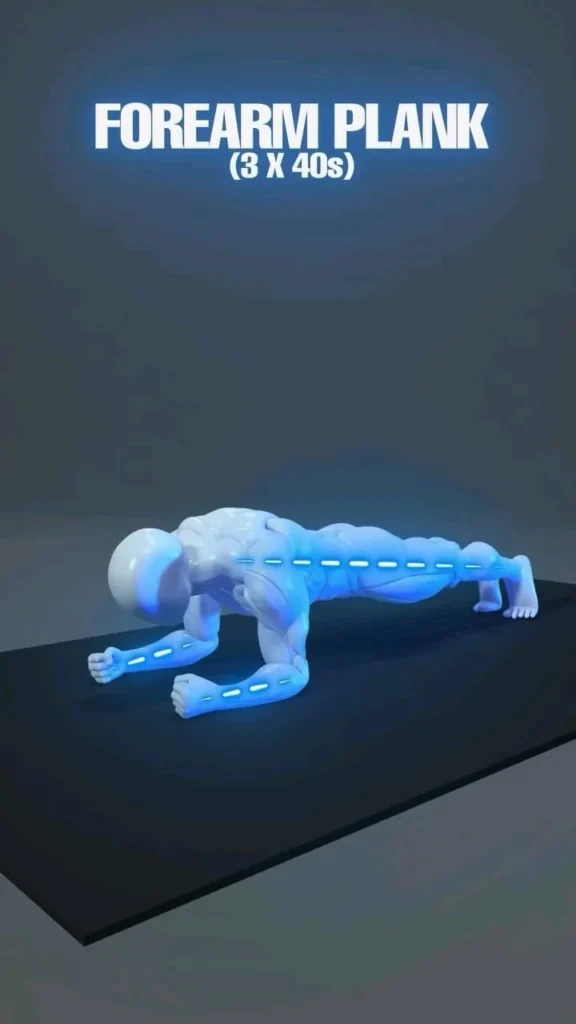
  • Balance: combine anti-flexion (planks), anti-rotation (pallof press variations), rotational (Russian twists), and dynamic flexion (leg raises) movements.

If you want a structured routine that focuses on a few high-impact moves, consider the Top 4 Abs Exercises Routine for a concise template to follow.

Sample Workouts

Beginner (2–3x per week)

  • Dead Bug — 3 sets of 8–12 reps per side
  • Front Plank — 3 × 20–45 seconds
  • Standing Pallof Press (light band) — 3 × 10–12 per side

Intermediate (3x per week)

  • Hanging Knee Raises — 3 × 10–15
  • Side Plank with Hip Drop — 3 × 8–12 per side
  • Russian Twist (medicine ball) — 3 × 12–20 total

Advanced (2–3x per week)

  • Hanging Leg Raises to Toes — 4 × 8–12
  • Weighted Decline Sit-Up — 4 × 8–12
  • Cable Anti-Rotation (heavy) — 4 × 8–10 per side

Mix stability-focused sets with higher-rep dynamic work to train both endurance and strength.

Technique Tips & Common Mistakes

  • Breathe rhythmically: exhale during the effort (e.g., curl or crunch) and inhale during release.
  • Control movement: avoid momentum-driven reps; slower eccentrics build strength and reduce injury risk.
  • Protect the low back: if you feel lumbar pain during leg raises, regress to bent-knee variations or perform anti-extension planks.
  • Progress sensibly: add resistance, range, or instability only after mastering form.
  • Recovery: treat abs like other muscles — allow at least 48 hours when performing high-intensity sets.

Equipment Options

You don’t need a gym to train your abs well. Useful tools:

  • Resistance bands for anti-rotation work
  • Medicine ball or dumbbell for loaded rotation
  • Pull-up bar for hanging leg raises
  • Stability ball for rollouts and stir-the-pot variations

Choose tools that challenge your weak links while letting you maintain good form.

Conclusion

A complete abs routine blends stabilization, rotation, and dynamic flexion with progressive overload and smart recovery. For a large library of demonstrations to help you vary and execute effective exercises, check out this comprehensive guide to Abs Exercises: 150+ Free Video Exercise Guides | Muscle & Strength.

Abs Workout Read More »

, , , ,
Effective shoulder workout using cable machines for strength training

Shoulder Workout on cables

Shoulder Workout on Cables

Cables are an underappreciated tool for building well-rounded shoulders. They provide constant tension through a movement’s range of motion, allow easy angle changes, and reduce momentum cheating — all of which help isolate the deltoid heads and improve muscle activation. If you typically train with free weights, consider alternating with cables for a few cycles to address weak ranges and stability (for a dumbbell comparison, see dumbbell shoulder workout).

Below is a practical guide you can use to structure an effective cable-based shoulder session, whether you’re in a commercial gym or a home setup with a functional trainer.

Shoulder anatomy refresher

  • Anterior deltoid — front lift and pressing motions.
  • Lateral (middle) deltoid — arm abduction and width.
  • Posterior deltoid — horizontal abduction and external rotation; key for posture and rear-chain balance.

Cables allow you to target each head with precise lines of pull, and to emphasize portions of a motion (e.g., top tension on lateral raises or end-range contraction on rear delt flyes).

Warm-up (5–10 minutes)

  • General warm-up: 3–5 minutes light cardio or dynamic arm circles.
  • Specific warm-up: 2–3 light sets on the cable for movement patterns you’ll use (e.g., 15–20 reps of face pulls and low-resistance lateral raises).

Core cable shoulder exercises (how to do them)

  1. Cable Face Pull (rear delts + external rotators)

    • Setup: Rope attachment at upper pulley.
    • Execution: Pull the rope towards your face with elbows high, external rotate so palms face your ears at the end. Squeeze shoulder blades together.
    • Sets/reps: 3 × 12–20.
  2. Single-Arm Cable Lateral Raise (middle delts)

    • Setup: Handle at the lowest setting, stand side-on to the machine.
    • Execution: With a slight elbow bend, raise the arm out to the side to just above parallel. Keep torso upright and avoid shrugging.
    • Sets/reps: 3–4 × 10–15 each side.
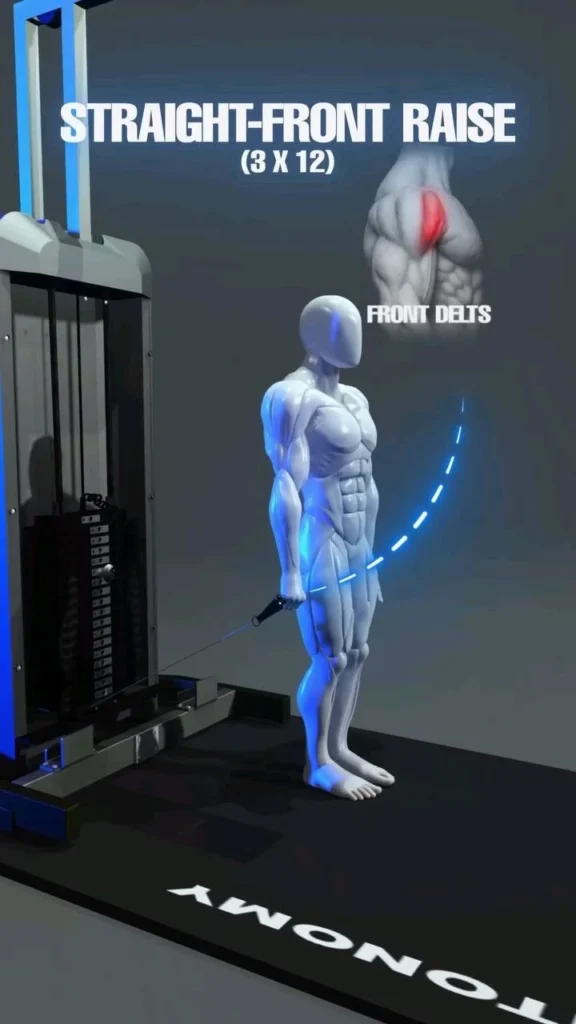
  3. Cable Front Raise (anterior delts)

    • Setup: Use a handle or rope from the lowest point; both arms or single arm.
    • Execution: Raise the handle to eye level or slightly higher, leading with the elbow. Slow eccentric control.
    • Sets/reps: 3 × 8–12.
  4. Cable Overhead Press (vertical pressing)

    • Setup: Handles set low, stand facing away and press overhead or use a single pulley with both hands.
    • Execution: Press up and slightly back to maintain a natural shoulder plane; don’t hyperextend the low back.
    • Sets/reps: 3–4 × 6–10.
  5. Cable Rear Delt Fly / High-Pulley Reverse Fly

    • Setup: Two high pulleys or a crossover; cross arms and pull across body with elbows slightly bent.
    • Execution: Focus on squeezing the rear delts at the end range; avoid using momentum.
    • Sets/reps: 3 × 12–15.
  6. Cable Upright Row (light, to emphasize traps/middle deltoid)

    • Setup: Straight bar on low pulley.
    • Execution: Pull to collarbone height with elbows leading; keep range comfortable to avoid impingement.
    • Sets/reps: 2–3 × 8–12 (use lighter loads, strict form).

Sample session templates

  • Hypertrophy-focused (45–60 minutes):

    • Warm-up.
    • Cable Overhead Press 4 × 8–10.
    • Single-Arm Cable Lateral Raise 4 × 12 each.
    • Cable Rear Delt Fly 3 × 15.
    • Cable Front Raise 3 × 12.
    • Face Pulls 3 × 15.
  • Strength / power (30–45 minutes):

    • Warm-up.
    • Cable Overhead Press 5 × 4–6 (heavier).
    • Superset: Single-Arm Lateral Raise 3 × 8 + Face Pull 3 × 12.
    • Light technical work on rear delts 3 × 15.

Progression and variation ideas

  • Tempo: Slow eccentrics (3–4 seconds) increase time under tension.
  • Partial reps: Top-half holds for lateral raises to overload the contraction.
  • Drop sets: End with a drop set on lateral raises or front raises for hypertrophy.
  • Unilateral focus: Work single-arm to remove bilateral compensation and build stability.

Pairing and programming tips

  • Frequency: Train shoulders 1–2 times per week directly; cables are easy to use for supplementary mid-week sessions.
  • Pairing: Cable shoulder work pairs well with chest or back sessions; you can finish a back day with face pulls and rear delt work.
  • Balance push/pull: For structural balance, include posterior chain and rotator cuff work. If you like finishing arms, consider a targeted arms routine afterwards — for a barbell-only arms finish, try this barbell biceps routine as a pairing option: 4 biceps exercises — barbell-only.

Common mistakes to avoid

  • Using too much weight: Cables can encourage momentum; prioritize form and full ROM.
  • Shrugging on lateral raises: Trap dominance reduces lateral delt stimulus.
  • Neglecting rear delts: Posterior delts are essential for shoulder health and posture.
  • Poor pulley alignment: Adjust cable height to match the plane of motion you want to target.

Safety cues

  • Maintain scapular stability; don’t let shoulders roll forward.
  • Keep core braced during standing cable presses.
  • Warm rotator cuff before heavy work with light external rotations on the cable or band.

Conclusion

Cables are a versatile, joint-friendly tool for building shoulder size, strength, and resilience. For a ready set of cable-focused movements and sample variations to plug into your routine, check out 6 Shoulder Cable Workouts For Stronger Shoulders | SQUATWOLF.

Shoulder Workout on cables Read More »

, , , ,
Dumbbell shoulder workout for strength training and muscle building

Shoulder Workout on dumbbells

Shoulder Workout Using Dumbbells: Build Strong, Defined Shoulders at Home or in the Gym

Strong, well-developed shoulders improve posture, athletic performance, and the overall look of your upper body. Dumbbells are one of the most versatile tools for training the deltoids, allowing unilateral work, natural joint pathways, and a wide variety of angles. If you want a focused plan, start here — and if you need a ready routine to follow, check out this guided dumbbell shoulder workout to get inspired.

Shoulder anatomy primer

  • Anterior deltoid: front of the shoulder, primary mover for pressing and front-raise movements.
  • Lateral (middle) deltoid: gives width to your shoulders; targeted by lateral raises and upright rows.
  • Posterior deltoid: rear of the shoulder; activated with reverse flies and face pulls.
    Balanced development means training all three heads with pressing, lateral, and rear-delt movements.

Warm-up (5–10 minutes)

  • Light cardio: 3–5 minutes to raise body temperature (jump rope, bike, brisk walk).
  • Shoulder-specific mobility: arm circles, band pull-aparts, shoulder dislocations with a band or PVC.
  • Warm-up sets: 1–2 light sets of overhead presses or lateral raises (50% load) for 8–12 reps.

Core dumbbell shoulder exercises (technique + programming)

These are the foundational moves to include in most workouts. Aim for the rep ranges listed depending on your goal.

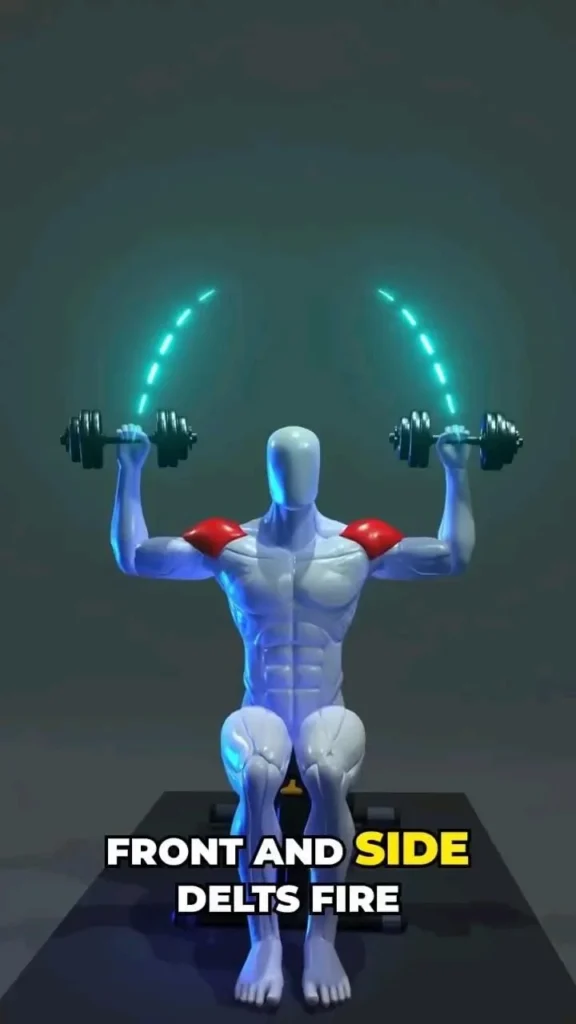
  1. Standing/Seated Dumbbell Overhead Press

    • Targets: anterior and lateral deltoids, triceps, upper chest.
    • Sets/Reps: 3–5 sets of 4–8 (strength) or 8–12 (hypertrophy).
    • Tip: Keep a neutral spine, brace your core, press in a slightly diagonal path for comfort.
  2. Arnold Press

    • Targets: all three deltoid heads with extra anterior focus.
    • Sets/Reps: 3 sets of 8–12.
    • Tip: Rotate palms during the press to drive balanced activation and full ROM.
  3. Dumbbell Lateral Raise

    • Targets: lateral deltoids for width.
    • Sets/Reps: 3–4 sets of 10–15.
    • Tip: Slight elbow bend, lead with the elbows, avoid shrugging. Use moderate weight and strict tempo.
  4. Dumbbell Front Raise

    • Targets: anterior deltoid.
    • Sets/Reps: 2–3 sets of 10–15.
    • Tip: Can be done one arm at a time to reduce momentum; control the descent.
  5. Bent-Over Reverse Fly (or Rear-Delt Fly)

    • Targets: posterior deltoid and upper back.
    • Sets/Reps: 3 sets of 10–15.
    • Tip: Hinge at the hips, keep a neutral neck, and squeeze shoulder blades at the top.
  6. Upright Row (wide grip, dumbbells)

    • Targets: lateral deltoids and traps.
    • Sets/Reps: 2–3 sets of 8–12.
    • Tip: Pull elbows high and wide; if you have shoulder impingement, substitute with lateral raises.
  7. Cuban Press (rotator cuff-friendly)

    • Targets: rotator cuff, rear delts, and overall shoulder health.
    • Sets/Reps: 2–3 sets of 8–12.
    • Tip: Use light weight and strict control to protect the shoulder joint.

Programming and progression

A simple approach: train shoulders directly 1–2x per week, or include a focused shoulder day plus indirect work on push days. Alternate heavier low-rep phases (4–6 reps) with hypertrophy phases (8–15 reps) every 4–8 weeks. For more exercise variety and single-equipment options, review this collection of dumbbells-only shoulder exercises that fit different experience levels.

Progression tips:

  • Increase load gradually (2.5–5% increments) once you can complete the top of your rep range with solid form.
  • Track volume (sets × reps × load) and aim to increase it weekly or biweekly.
  • Use tempo manipulation (slow negatives) or drop sets for added intensity without much heavier weights.

Common mistakes and how to avoid them

  • Using momentum on lateral/front raises: reduce weight and focus on control.
  • Over-emphasizing pressing at the expense of rear delts: include at least one rear-delt movement per session.
  • Neglecting rotator cuff work: include external-rotation exercises or Cuban presses to maintain shoulder health.
  • Poor posture: strengthen upper back and perform mobility work to improve scapular positioning.

Sample workouts

Beginner (2× per week)

  • Warm-up
  • Seated Dumbbell Press: 3×8–10
  • Lateral Raises: 3×12–15
  • Bent-Over Reverse Fly: 3×12
  • Light Cuban Press: 2×15

Intermediate (1–2× per week)

  • Warm-up
  • Standing Dumbbell Press: 4×6–8
  • Arnold Press: 3×8–10
  • Lateral Raises (superset with) Front Raises: 3×10–12 each
  • Upright Rows (wide): 3×8–10
  • Bent-Over Reverse Fly: 3×12–15

Advanced (power + hypertrophy)

  • Warm-up
  • Heavy Single-Arm Seated Press: 5×4–6 (each arm)
  • Drop-Set Arnold Press: 3×8 → drop weight ×6 → drop ×6
  • Pause Lateral Raises (2s top): 4×10–12
  • Bent-Over Reverse Fly (4s negative): 4×12
  • Finisher: Farmer carries or shrugs for trap balance

Recovery and supporting factors

  • Sleep: aim for 7–9 hours for optimal muscle recovery.
  • Nutrition: prioritize protein (0.7–1.0 g/lb bodyweight) and sufficient calories to support growth.
  • Mobility: daily thoracic and scapular mobility reduces injury risk.
  • Frequency: more frequent, moderate-volume sessions often trump one infrequent high-volume session.

Conclusion

For a curated list of movements to expand your dumbbell shoulder library, see the 13 Best Dumbbell Shoulder Exercises which pairs well with the routines above and provides variations to keep your workouts fresh.

Shoulder Workout on dumbbells Read More »

, , , ,
Woman performing a tiny waist workout routine for a toned waistline

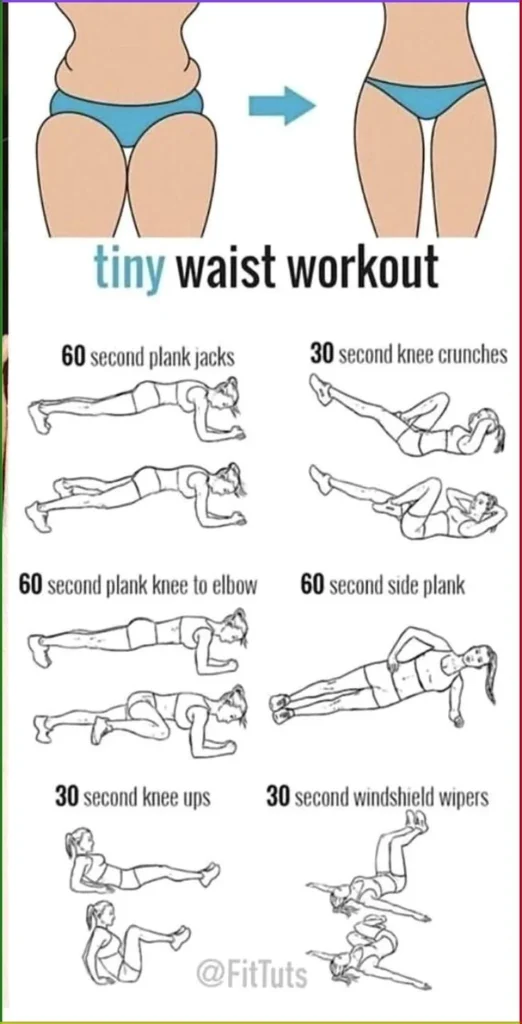
Quick and Effective Tiny Waist Workout Routine

Quick and Effective Tiny Waist Workout Routine

Introduction
A tight, sculpted waist comes from a mix of targeted core work, posture-aware strength training, and smart conditioning — not endless crunches. This routine focuses on deep core stabilization, oblique shaping, and metabolic boost to help you slim and define your midsection efficiently. For balanced results, pair core work with upper-body and arm strength; complementary programs such as 4 Effective Biceps Exercises can help maintain proportional symmetry while you trim your waist.

Warm-up (5 minutes)

  • Cat-cow x 8–10: mobilize spine and activate deep core.
  • Standing hip circles x 10 each side: loosen obliques and hips.
  • Dynamic plank walkouts x 6: prime shoulders and core.

Core Foundations (focus on deep activation)

  1. Hollow Hold — 3 x 20–40 seconds
  • Lie on your back, lower back pressed to floor, hands overhead. Lift shoulders and legs slightly; breathe steady. Short holds build the transverse abdominis, the muscle that pulls the waist inward.
  1. Dead Bug — 3 x 8–12 each side
  • Lying on back, knees bent 90°, slowly extend opposite arm and leg while keeping lower back glued to floor. Great for anti-extension control.
  1. Pallof Press (Band or cable) — 3 x 10–12 each side
  • Stand perpendicular to anchor, press band straight out and resist rotation. Excellent anti-rotation for trimming love handles.
  1. Side Plank with Hip Dips — 3 x 10–12 dips each side
  • Emphasizes obliques and lateral chain for a tapered waistline.

Quick 15-minute Circuit (do 3 rounds, rest 60–90s between rounds)

  • 45s Russian Twist (control, weighted or bodyweight) / 15s rest
  • 45s Hollow Hold / 15s rest
  • 45s Mountain Climbers (fast, drive knees) / 15s rest
  • 45s Plank to Knee Tap (front plank, bring knee to elbow alternating) / 15s rest

Technique Tips

  • Breathe: exhale on effort. Diaphragm control maintains core tension and appearance.
  • Spine neutral: avoid overarching the low back during hollow variations — this shifts effort away from the deep core.
  • Progression: increase hold times, add light resistance, or shorten rest between intervals to make workouts harder without extra exercises.

Accessory and Posture Work

  • Single-leg Romanian deadlifts: build posterior chain so pelvis sits neutral rather than anteriorly tilted.
  • Face pulls and scapular retractions: strong upper back improves posture and visually narrows the waistline.
  • If you’re including arm-focused accessory days, a straightforward barbell-only approach like 4 Biceps Exercises Routine — Barbell Only fits easily into a weekly split without derailing core progress.

Nutrition and Frequency

  • Aim for 3–5 focused core sessions per week combined with 2–3 full-body or resistance-training workouts. Short, intense HIIT cardio (10–20 minutes) 2 times weekly helps with overall fat loss.
  • Preserve muscle and reveal a smaller waist by prioritizing protein (0.7–1.0 g/lb bodyweight), a small calorie deficit if fat loss is the goal, and steady hydration.

Sample Weekly Structure

  • Monday: Core circuit + upper-body strength
  • Tuesday: HIIT + mobility
  • Wednesday: Lower-body strength + short core finishes
  • Thursday: Active recovery or yoga
  • Friday: Core circuit + full-body conditioning
  • Weekend: Light cardio, mobility, and rest as needed

Progress Tracking

  • Measure with tape at the narrowest point of your waist and track every 2–3 weeks.
  • Take progress photos in consistent lighting and posture.
  • Focus on performance gains (longer holds, cleaner reps) as much as the number on the tape.

Conclusion

For a deeper collection of moves that target the deep core and help create a snatched waistline, check out this guide: 10 Deep Core Exercises For a Snatched Waist | Hourglass Body …

Quick and Effective Tiny Waist Workout Routine Read More »

, , , ,
Intense Shoulders ON FIRE workout routine for strength and muscle definition.

Shoulders ON FIRE Workout Routine

Shoulders ON FIRE Workout Routine

Ignite your delts and build rounded, powerful shoulders with this focused Shoulders ON FIRE routine. It blends compound pressing strength, targeted lateral and rear delt isolation, and metabolic finishers to maximize growth and definition. Before you start, make sure your shoulder mobility and rotator cuff strength are primed — if you want an idea for pairing arm work after shoulders, check this barbell biceps routine that complements heavy pressing days.

What you’ll need:

  • Dumbbells (light, medium, heavy)
  • Barbell or Smith machine (optional)
  • Cable machine or resistance band
  • Bench (flat or incline)
  • Light kettlebell (optional)

Principles behind the routine:

  • Start each session with movement prep and progressive loading.
  • Prioritize posterior (rear) delts to avoid imbalance from heavy pressing.
  • Use supersets and tri-sets to increase time under tension and metabolic demand.
  • Finish with high-rep burnouts for capillary density and definition.

Warm-up (8–12 minutes)

  • 5 minutes light cardio (rower, bike, or jump rope)
  • Band pull-aparts: 2 x 15
  • Scapular wall slides: 2 x 12
  • Empty-can raises (light): 2 x 12 each arm
  • 2 sets of 10 reps with a light dumbbell overhead press to groove movement pattern

Shoulders ON FIRE Routine (perform 1–2 times per week)

Do this routine after compound chest/back work or as a dedicated shoulder day. Rest 60–90 seconds between sets unless otherwise noted.

  1. Heavy Compound Press
  • Standing barbell or dumbbell overhead press — 4 sets: 6–8, 6, 8, 10 (drop weight each set)
    Purpose: Build strength and long-term mass on the anterior and lateral heads.
  1. Superset A — Lateral Emphasis
  • Dumbbell lateral raises — 4 sets x 12–15
  • Leaning cable lateral raise or single-arm band lateral raise — 4 sets x 12 each side
    Notes: Control the eccentric. Pause for a 1-second hold at peak on the last rep.
  1. Superset B — Rear Delt & Upper Back
  • Incline bench rear delt flyes (or bent-over DB reverse fly) — 4 sets x 12–15
  • Face pulls (rope) — 4 sets x 15–20
    Purpose: Balance the shoulder capsule and improve posture.
  1. Tri-set C — Volume & Burn
  • Arnold press (light–moderate) — 3 sets x 10–12
  • Upright rows (wide grip to hit lateral delts, or cable high pull) — 3 sets x 10–12
  • Seated dumbbell press (strict) — 3 sets x 8–10
    Notes: Move quickly between exercises. Use the tri-set to create metabolic stress.
  1. Finisher — High-Rep Burnout
  • Plate raises or kettlebell halos — 2 sets x AMRAP (aim 25–50)
  • Alternatively: 2 rounds of 30/30s lateral raises on each side with a 15–20 second rest

Technique & Progression Tips

  • Focus on scapular stability during presses; the motion should come from the shoulder joint, not excessive back arching.
  • When doing lateral raises, lead with the elbow and keep a slight bend to reduce joint stress.
  • Progressive overload: increase reps first, then weight. Track weekly volume (sets x reps x load).
  • Deload every 4–8 weeks depending on recovery. On deload weeks reduce volume by ~40–50%.

Accessory Pairing & Recovery

Pair this shoulder routine with a pulling-heavy back day or lighter arm work to avoid overtaxing pressing patterns. If you like pairing arms on shoulder day, try integrating targeted biceps work for balance — here’s an example of effective biceps exercises that won’t overly fatigue your pressing muscles when done after shoulders.

Recovery:

  • Prioritize sleep and protein intake (0.7–1.0 g/lb bodyweight).
  • Use soft tissue work and mobility drills for the thoracic spine and rotator cuff.
  • Ice only for acute pain; otherwise emphasize movement and gentle heat to promote blood flow.

Sample 6-Week Progression Plan

Week 1–2: Establish form, moderate weights, high control (8–12 rep ranges)
Week 3–4: Increase load on compound presses, add one extra set on lateral work
Week 5: Peak volume — include an extra tri-set and extended finisher
Week 6: Deload — reduce sets and intensity by ~40%

Safety Notes

  • If you experience sharp pain (not typical muscle burn), stop and consult a professional.
  • Avoid excessive behind-the-neck pressing if you have limited shoulder mobility.
  • Scale weights conservatively for unilateral exercises to avoid asymmetry.

Conclusion

Ready to set your shoulders ablaze? For a printable, structured plan to follow alongside this routine, check out the Fire Workout document for a compact template you can bring to the gym.

Shoulders ON FIRE Workout Routine Read More »

, , , ,
Effective exercises for achieving a slim waist including side bends and Russian twists

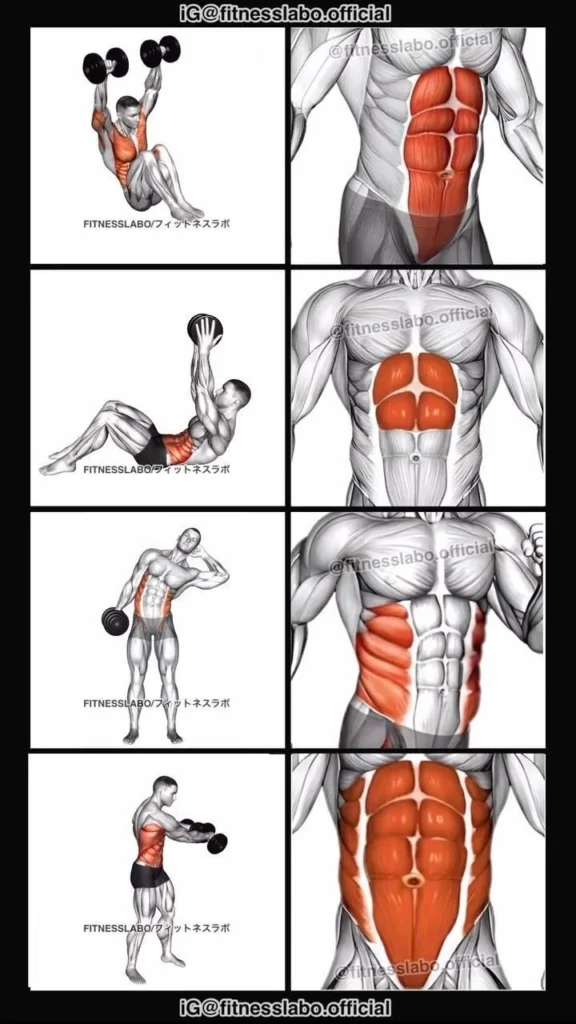
「「𝗙𝗜𝗧𝗡𝗘𝗦𝗦𝗟𝗔𝗕𝗢 on Instagram: “✅ How to Get a Slim Waist ① Spell Caster ② Physique 8 ③ Side Bend ④ Russian Twist 3 sets 15-20 reps #fitness #gym #ex…」[動画]」[動画]【2025】 | 腹筋のルーティン, 腹部のエクササイズ, ジムのエクササイズ

Slim Waist Routine (2025) — A Practical Guide to the Instagram 4-Move Ab Circuit

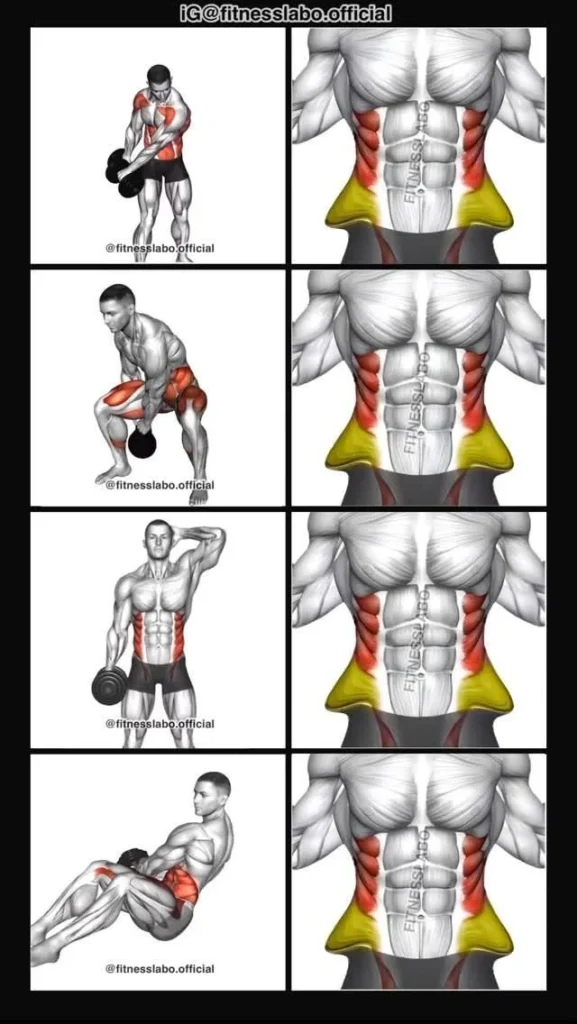
A popular Instagram clip from FITNESSLABO recently circled the feed with a compact four-move abdominal circuit promising a slimmer waist: Spell Caster, Physique 8, Side Bend, and Russian Twist — 3 sets of 15–20 reps each. It’s a simple, high-volume routine that can be done in the gym or at home with minimal equipment. Before you start, make sure you’re following a basic gym-safety routine to protect your back and joints — here’s a useful gym safety checklist to review first.

Below is a practical breakdown of each move, coaching cues, and ways to scale the circuit so it’s effective and safe.

The four-move circuit — what each exercise does and how to perform it

  1. Spell Caster

    • What it targets: anti-rotation and transverse abdominis engagement; trains core stability through standing rotation.
    • How to do it: Stand feet hip-width apart, hold a light weight or medicine ball at chest level. Rotate your torso slowly to one side while maintaining a braced core, then return to center and rotate to the other side. Think of “casting” the weight across your body in a controlled arc.
    • Tips: Keep hips relatively stable; avoid using momentum. Maintain neutral spine and breathe steadily.
  2. Physique 8

    • What it targets: lower abs and hip control with a figure-8 leg pathway.
    • How to do it: Lie on your back, lift legs slightly off the floor. Move the legs in a slow figure-eight pattern, focusing on controlled motion from the hips and lower abs rather than momentum from the legs.
    • Tips: Keep the lower back gently pressed into the floor; if you feel arching, raise the legs a little higher or reduce range of motion.
  3. Side Bend

    • What it targets: obliques and lateral flexors.
    • How to do it: Standing or seated, hold a dumbbell in one hand and lower it toward the knee on the same side by bending at the waist, then return to upright. Repeat for reps and switch sides.
    • Tips: Don’t rush through reps; avoid rotating the torso — aim for pure lateral flexion. Use moderate weight to avoid compensations.
  4. Russian Twist

    • What it targets: rotational strength for the obliques and the entire core.
    • How to do it: Sit with knees bent and heels near the floor, lean back slightly to engage the core, hold a weight or medicine ball and rotate the torso from side to side. Move with control and full breathing.
    • Tips: Keep shoulders relaxed and spine tall; if lower back discomfort appears, reduce range of motion or perform the movement with feet on the floor.

Routine format: 3 sets × 15–20 reps per exercise. Rest 45–60 seconds between sets. Adjust reps and load based on form quality — perfect reps win over high rep counts.

Programming, progressions, and alternatives

  • Frequency: 2–4 core-focused sessions per week is sufficient. Combine this circuit with compound lifts and cardiovascular work for best results in waistline reduction.
  • Progressive overload: Add weight, slow the tempo, or increase time-under-tension before increasing reps. For example, hold a longer isometric pause at the end range of a Spell Caster or perform slow 3–4 second eccentrics on the Physique 8.
  • Regressions: Reduce range of motion, perform fewer reps per set (8–12), or substitute seated or supported versions of the moves until you build strength.
  • Variations: To add variety and build rotational power, consider resisted alternatives such as band rotations. A helpful band twist tutorial explains safe progressions and cues for using bands to strengthen the core while protecting the spine.

Common mistakes to avoid: swinging the weight, holding breath, flaring ribs, and letting the lower back dominate the movement. Quality reps at moderate intensity beat sloppy high-volume sets.

Sample 12-minute circuit (beginner to intermediate)

  • Warm-up: 3 minutes — light cardio + dynamic hip and thoracic mobility
  • Circuit: Perform each exercise back-to-back (15 reps each), rest 60 seconds after the four exercises, repeat for 3 rounds.
  • Cool-down: 2–3 minutes — gentle stretching and diaphragmatic breathing

This short, focused training session fits easily into most workout schedules and reinforces core stability, rotational control, and oblique strength — all contributing to a tighter waistline when combined with nutrition and overall fat-loss strategies.

Conclusion

The Spell Caster → Physique 8 → Side Bend → Russian Twist circuit is a practical, time-efficient way to train your core. Prioritize correct technique, progressive overload, and gym safety. When done consistently alongside a sensible diet and full-body training, these exercises can help sculpt a leaner midsection.

「「𝗙𝗜𝗧𝗡𝗘𝗦𝗦𝗟𝗔𝗕𝗢 on Instagram: “✅ How to Get a Slim Waist ① Spell Caster ② Physique 8 ③ Side Bend ④ Russian Twist 3 sets 15-20 reps #fitness #gym #ex…」[動画]」[動画]【2025】 | 腹筋のルーティン, 腹部のエクササイズ, ジムのエクササイズ Read More »

, , , ,
Flat belly workout exercises for a toned midsection.

ボード「Flat belly workout」のピン

From a Pin to a Plan: Building a Realistic Flat-Belly Workout Routine

A single pin on a board labeled "Flat belly workout" can spark a lot of ideas — short circuits, exotic moves, and the promise of quick results. But turning inspiration into sustainable progress requires context: efficient exercises, consistent habits, realistic expectations, and an understanding of common fitness myths. If you clicked on that pin hoping for an instant transformation, start here with a practical path from pin to plan. For a deeper look at why some promises are misleading, see this explanation of the spot reduction myth.

Why a Pinterest Pin Isn’t a Complete Plan

Pins are visual and motivating, but they usually lack critical details: progression, frequency, nutrition, and recovery. A balanced approach addresses:

  • Strength (to shape and support your core)
  • Cardiovascular fitness (to help with overall fat loss)
  • Mobility and posture (so your results look and feel functional)
  • Nutrition and sleep (which drive body composition changes)

Keep in mind that visible abdominal definition is affected by overall body fat, genetics, and hormone balances — not only by which abs moves you do.

Core Principles for a Real Flat-Belly Routine

Follow these principles rather than copying random sequences from pins:

  • Progressive overload: increase difficulty or volume over time.
  • Multi-planar movement: include anti-flexion (planks), anti-rotation (pallof presses), and loaded carries, not just crunches.
  • Consistency over intensity: short, frequent sessions beat sporadic extremes.
  • Diet quality and caloric balance: moderate calorie control and protein support muscle retention.

If you want a science-based debunking of quick fixes and myths linked to core workouts, refer to this clear overview: why spot reduction is a myth.

A Simple Weekly Template (Beginner to Intermediate)

Aim for 3–5 sessions per week, mixing core-focused work with full-body strength and cardio:

  • Day 1 — Full-body strength + 8–12 min core finisher (plank progressions, dead bugs)
  • Day 2 — Low-intensity steady-state cardio or active recovery
  • Day 3 — HIIT (15–20 minutes) + loaded carries (farmer carries)
  • Day 4 — Mobility/yoga and breathing work
  • Day 5 — Strength emphasis (squats/hinges) + anti-rotation/core stability
  • Weekend — Light activity, walks, and nutrition planning

Sample core finisher (10 minutes):

  • 45s plank, 15s rest
  • 30s dead bugs, 15s rest
  • 30s side plank (each side), 15s rest
  • 60s farmer carry (or suitcase carry)
    Repeat until 10 minutes is reached. These moves build tension and transfer to real-life posture better than endless sit-ups.

Nutrition, Recovery, and Lifestyle

Abdominal appearance is highly sensitive to body fat and bloating:

  • Aim for a modest calorie deficit or maintenance with body-composition-focused goals.
  • Prioritize protein (1.2–1.8 g/kg bodyweight) and whole foods for satiety.
  • Hydrate and reduce sodium-heavy processed foods to minimize bloating.
  • Sleep 7–9 hours — poor sleep increases cravings and slows recovery.
  • Manage stress; chronic cortisol elevation can affect abdominal fat distribution.

Common Pitfalls to Avoid

  • Chasing 6-pack-only moves: Core strength is more than aesthetics.
  • Expecting rapid change from brief viral workouts.
  • Ignoring posture and breathing: diaphragmatic breathing and pelvic control matter.
  • Overtraining the abs: they recover like other muscles and need rest.

Practical Tips for Turning Pins into Progress

  • Save the pin as a reference, then build a weekly plan incorporating its best elements.
  • Track progress with photos, performance metrics (plank hold time, loaded carry distance), and measurements, not just scale weight.
  • Use variety: rotate exercises every 4–6 weeks to keep strength and motivation improving.
  • Work with coaches or reputable resources when unsure about form or programming.

Conclusion

If a Pinterest board kickstarted your journey, convert that inspiration into a balanced routine combining strength, cardio, recovery, and sensible nutrition. For curated programs and quick-start products that some people use to supplement a structured plan, consider checking the Hot flat tummy in 7 days Store.

ボード「Flat belly workout」のピン Read More »

, , , ,
At-home abs workout featuring Dragon Flag, Laying Hip Raises, and more.

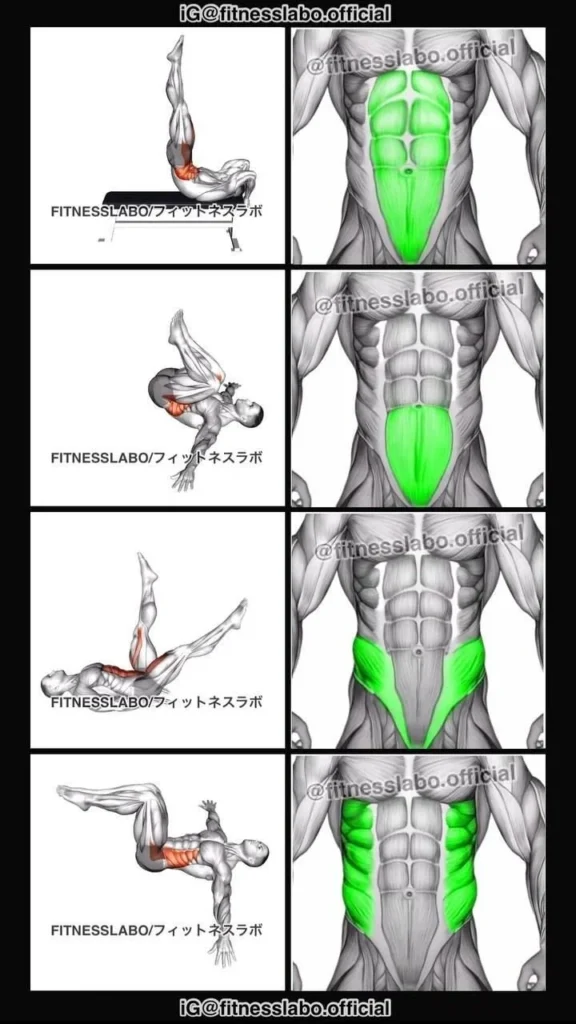
「「𝗙𝗜𝗧𝗡𝗘𝗦𝗦𝗟𝗔𝗕𝗢 on Instagram: “✅ Abs Workout at Home ① Dragon Flag 10×3 ② Laying Hip Raise 10×3 ③ Alternate Leg Raise 20×3 ④ Half Wipers 20×3 #fitness #…」[動画]」[動画]【2025】 | トレーニングプラン, 腹筋のルーティン, 家でできるエクササイズ

Home Abs Routine: The 2025 Dragon Flag Circuit

Want a simple, high-impact ab routine you can do at home? This nine-minute style circuit focuses on four brutal core moves you can do with no equipment. The template below is adapted from a popular Instagram routine and optimized for progressive strength and safety so you can build control and visible results.

If you want to pair this core day with a simple upper-body push session later in the week, try the towel push-up and dip variations — they complement core work without needing a gym.


The Routine (3 rounds)

Perform each exercise in sequence. Rest 60–90 seconds between rounds.

  • Dragon Flag — 10 reps x 3 sets
    Cue: Lie on a bench or the floor, grab something secure behind your head, keep your body rigid, and lower slowly with control. Focus on a tight hollow position. If full dragon flags are too hard, use the regression tips below.

  • Lying Hip Raise — 10 reps x 3 sets
    Cue: Keep the pelvis tucked and lift hips toward the ceiling using your lower abs and glutes. Pause at the top for one second, then descend slowly.

  • Alternate Leg Raise — 20 reps (10 per leg) x 3 sets
    Cue: From a supine position, lift one leg at a time while keeping the other lightly off the floor. Keep the lower back pressed into the mat.

  • Half Wipers — 20 reps (10 each side) x 3 sets
    Cue: Legs extended toward the ceiling, drop legs to one side about 45°, return to center, then to the other side. Keep shoulders flat and core engaged.


Exercise Details & Technique Tips

  • Dragon Flag tips: Squeeze your lats, brace the core, and initiate movement from the ribcage. Move slowly—tempo is more important than range for building control.
  • Lying hip raise form: Emphasize posterior pelvic tilt at the top to fully engage the lower abs. Don’t overarch the lower back.
  • Alternate leg raises: Keep hands under your glutes for support if you feel lower-back strain. Control the downward phase—don’t let gravity pull you.
  • Half wipers: Limit range if you feel shoulder lift; keep elbows light and scapula pinned.

Regressions: bent-knee dragon negatives, single-leg hip raises, or reduced ROM on leg raises. Progressions: weighted hip raises (light dumbbell or plate), slow eccentrics, or controlled isometric holds at the top.


How to Structure This in a Weekly Plan

A balanced weekly split might look like:

  • Day 1: Full-body strength + core circuit (this routine)
  • Day 2: Active recovery or light cardio
  • Day 3: Lower-body focus — include glute strength work like deadlifts, sumo squats, and hip thrusts (see a helpful dumbbell-based glute sequence here: dumbbell glutes routine)
  • Day 4: Mobility & light core work
  • Day 5: Repeat or swap in another core variation

Pairing core days with targeted chest or glute sessions gives you balanced development and prevents overworking the same muscle groups two days in a row.


Programming Notes

  • Frequency: 2–3 times per week for general strengthening. Allow 48 hours recovery between intense core sessions.
  • Progression: Add 1–3 reps per set each week or increase time under tension (slower eccentric). Once 3×12 becomes manageable for each exercise, add a controlled progression or light resistance.
  • Warm-up: 5–10 minutes dynamic warm-up (hip circles, cat-cow, plank-to-push) before starting.
  • Safety: Stop if you feel sharp low-back pain. Focus on breathing—exhale on the exertion portion of each rep.

Conclusion

This at-home abs circuit is efficient, scalable, and targets the full midsection—from rectus abdominis to obliques and deep stabilizers. Start with conservative ranges, focus on strict technique, and progressively increase difficulty. Consistency and recovery will produce the best results.

「「𝗙𝗜𝗧𝗡𝗘𝗦𝗦𝗟𝗔𝗕𝗢 on Instagram: “✅ Abs Workout at Home ① Dragon Flag 10×3 ② Laying Hip Raise 10×3 ③ Alternate Leg Raise 20×3 ④ Half Wipers 20×3 #fitness #…」[動画]」[動画]【2025】 | トレーニングプラン, 腹筋のルーティン, 家でできるエクササイズ Read More »

, , , ,
Effective chest workout at home featuring towel flies and push-ups.

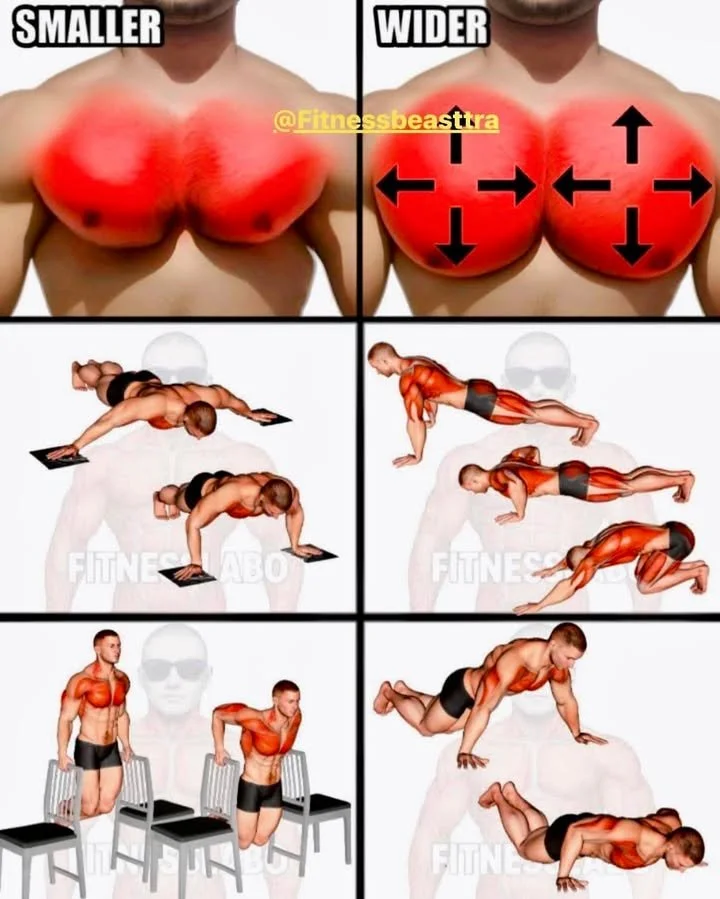
✅ Chest Workout At Home 🔥 1 Towel Chest Fly✅ 2 Push-up Pull✅ 3 Dips Between Chairs ✅ 4 Kneeling Push-up ✅ 3 sets 15 reps✅ #fblifestyle

Effective Chest Workout at Home

Looking to build strength and muscle in your chest without the need for any fancy equipment? Look no further! Here’s a simple yet effective chest workout routine that you can perform at home, using just a few basic items. This program includes exercises that target the chest muscles while also enhancing overall upper body strength.

Exercise Routine

1. Towel Chest Fly

Description: This exercise mimics the traditional chest fly movement using a towel to create resistance.

How to Do It:

  • Stand with your feet shoulder-width apart and hold a towel in both hands, stretching it at shoulder height.
  • With a slight bend in your elbows, open your arms wide, stretching the towel as you do.
  • Bring your arms back to the starting position.

Benefits: This move effectively targets the pectoral muscles and improves flexibility.

2. Push-up Pull

Description: A variation of the regular push-up that adds a pull component, utilizing momentum and balance.

How to Do It:

  • Start in a normal push-up position.
  • As you lower your body, pull one hand toward your body (as if pulling something towards you).
  • Return to the starting position and repeat on the other side.

Benefits: This exercise works the chest and engages other muscle groups such as the shoulders and arms.

3. Dips Between Chairs

Description: A fantastic bodyweight exercise that focuses on your chest, triceps, and shoulders.

How to Do It:

  • Place two sturdy chairs a few feet apart.
  • Support your body weight with your hands on the edges of the chairs and your legs extended between them.
  • Lower your body until your elbows are at about 90 degrees and then push back up to the starting position.

Benefits: Dips effectively target the lower part of the chest and build upper body strength.

4. Kneeling Push-up

Description: An excellent modification of the standard push-up, perfect for those building strength.

How to Do It:

  • Start on your knees with hands placed shoulder-width apart on the floor.
  • Lower your body to the ground by bending your elbows, then push back up to the starting position.

Benefits: This version reduces the intensity of a regular push-up, allowing you to focus on form and muscle engagement.

Workout Plan

Sets and Reps

Perform the following workout three times, completing 15 repetitions for each exercise:

  • Towel Chest Fly: 3 sets of 15 reps
  • Push-up Pull: 3 sets of 15 reps
  • Dips Between Chairs: 3 sets of 15 reps
  • Kneeling Push-up: 3 sets of 15 reps

Final Thoughts

This home chest workout is perfect for anyone looking to sculpt and strengthen the chest area without traditional gym equipment. Incorporate it into your routine three times a week for optimal results, and don’t forget to listen to your body and rest as needed.

Get ready to unleash the power of your chest with this effective at-home workout routine! 💪🔥

#fblifestyle

✅ Chest Workout At Home 🔥 1 Towel Chest Fly✅ 2 Push-up Pull✅ 3 Dips Between Chairs ✅ 4 Kneeling Push-up ✅ 3 sets 15 reps✅ #fblifestyle Read More »

, , , ,
Scroll to Top