
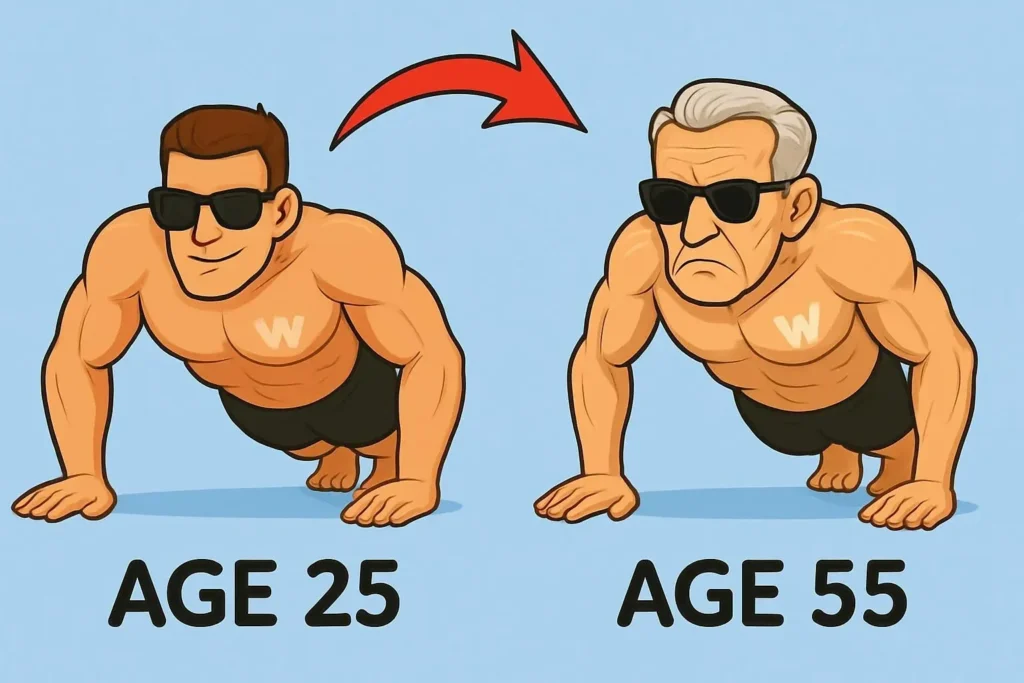
How Many Push-Ups Should You Be Able to Do at Your Age?
Push-Up Benchmarks by Age
Push-ups are a simple, effective way to gauge upper-body strength and overall fitness. Below you’ll find age-based benchmarks, testing tips, and progress strategies to help you know where you stand and how to improve. For targeted shoulder work that supports push-up performance, include specific shoulder-strengthening moves in your routine like those recommended in this guide: shoulder-strengthening moves.
What follows are practical, realistic push-up standards broken into age groups, plus form checks and training pointers you can use right away.
How to test a standard push-up
- Start in a high plank with hands under shoulders, body in a straight line.
- Lower until your chest is roughly an inch from the floor, then push back up.
- Keep elbows at about a 45-degree angle to your body; avoid flaring.
- Count only full-range reps with good form.
Age-based push-up benchmarks (average / good)
- 18–24: Men 15 / 30+ | Women 10 / 20+
- 25–34: Men 12 / 25+ | Women 8 / 18+
- 35–44: Men 10 / 20+ | Women 7 / 15+
- 45–54: Men 8 / 15+ | Women 5 / 12+
- 55–64: Men 6 / 12+ | Women 4 / 10+
- 65+: Men 4 / 10+ | Women 2 / 8+
Notes on the benchmarks
- "Average" indicates a reasonable norm for generally healthy, active people. "Good" indicates above-average fitness.
- Individual variation is large — body weight, training history, and technique matter.
- If standard push-ups are too hard, start with knee push-ups, incline push-ups, or wall push-ups and progress from there.
Training strategies to increase reps
- Progressive overload: add 1–3 reps per session or add an extra set each week.
- Volume structure: try 3–5 sets of 8–12 reps at a challenging intensity, or timed sets (e.g., max reps in 60 seconds).
- Variation: incorporate decline push-ups for extra challenge or close-grip/pike push-ups to target different muscles.
- Recovery: rest 48 hours between intense push-up-focused sessions.
- Nutrition and energy: small, carbohydrate-focused pre-workout snacks can help sustain performance during training.
Common form mistakes to avoid
- Sagging hips or a rounded back — tighten your core and glutes.
- Partial reps — only count full-range movement.
- Hands too wide or too narrow — aim for shoulder-width to slightly wider depending on target muscles.
- Holding breath — breathe out on the push phase.
Quick progress test protocol
- Warm up 5–10 minutes (dynamic shoulder and chest mobility).
- Do one set to failure with strict form; use this number as your baseline.
- Repeat the test every 4–6 weeks to track progress.
Conclusion
If you want a professional reference to compare your results and learn more about overall fitness measures, see this resource from the Mayo Clinic: How fit are you? See how you measure up – Mayo Clinic.
How Many Push-Ups Should You Be Able to Do at Your Age? Read More »