Unique Short Title: 30-Day Morning Calisthenics Reset
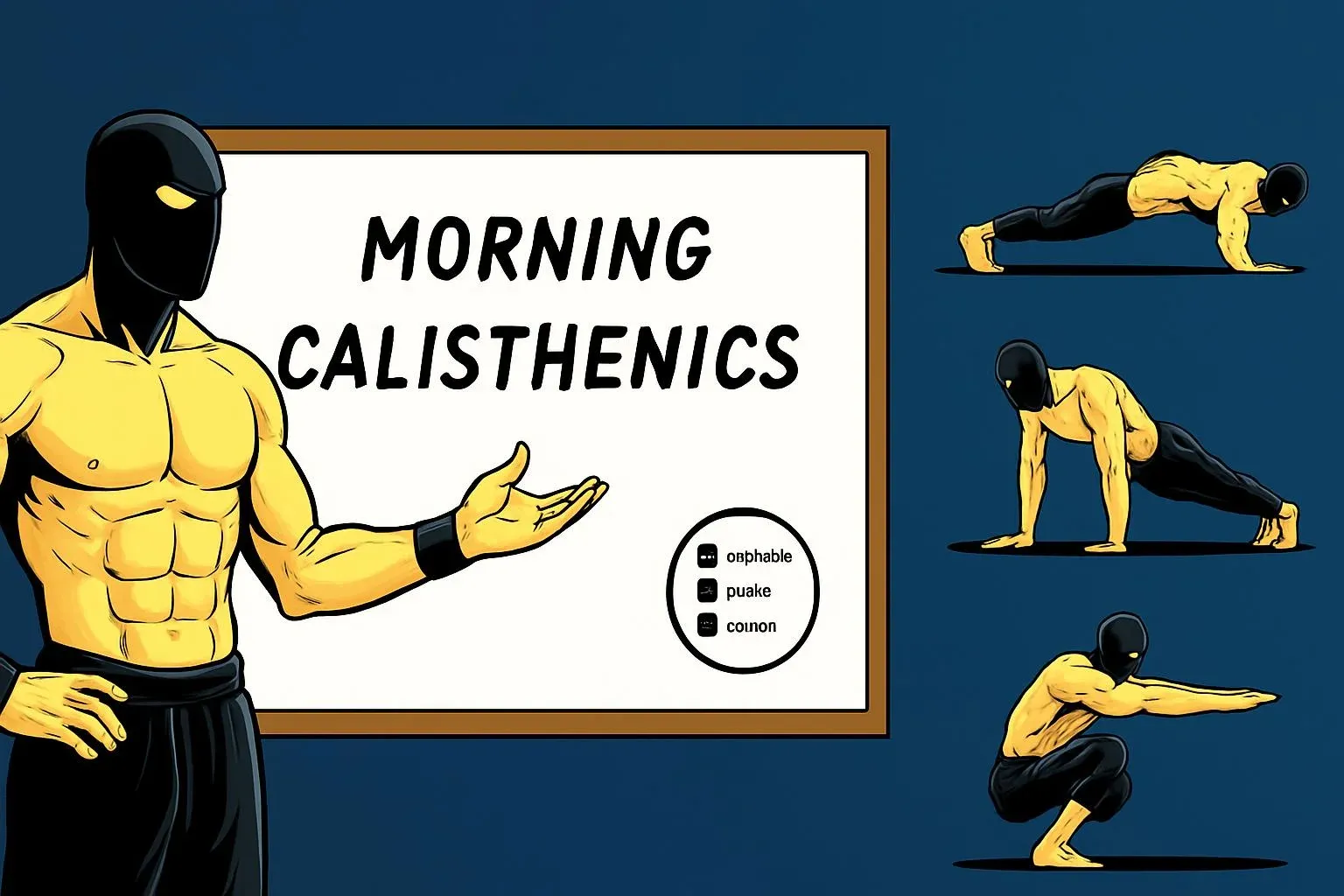
I started a simple beginner calisthenics morning routine and committed to it every day for 30 days to see what would change — energy, posture, strength, and habit formation were the goals. The routine was short (15–20 minutes), required no equipment, and focused on basic movements: joint warm-ups, push variations, core work, squats, and mobility.
What the routine looked like (daily, 15–20 minutes)
Warm-up (2–3 minutes): arm circles, hip circles, light jogging in place.
Why mornings? A short session first thing made it easier to be consistent and improved mindset for the rest of the day. If you want a complementary focused ab plan to rotate into your routine, I found inspiration from a structured program like this 30-day ab challenge.
Progress by week
Week 1: Learning movement patterns and dialing in consistency. The biggest win was showing up — mornings felt busier but doable.
Week 2: Noticed better posture and less morning stiffness. Push-up form improved quickly.
Week 3: Endurance increased; I could do more reps per set and needed less rest.
Week 4: Strength gains became tangible — smoother push-ups, firmer core, and higher confidence in balance and mobility.
Specific physical changes after 30 days
Strength: Push-up form progressed from incline to lower incline and occasional full push-ups. Squat depth became better and more stable.
Core: Improved control in hollow holds and tighter midline during daily activities.
Posture and mobility: Reduced forward shoulder rounding and less lower-back tightness.
Energy and habit: Morning energy was steadier; the routine became non-negotiable and took under 20 minutes.
How I tracked progress
Weekly photo and short video of one set of push-ups and a hollow hold.
Reps recorded in a simple note app.
Subjective energy and sleep notes.
Modifications and scaling
If full push-ups are too hard: start with wall or incline push-ups and increase the angle over time.
To progress rows: reduce foot support or move to a lower bar/edge.
To challenge core: add hanging knee raises or slow negative leg raises when ready.
Nutrition and recovery
Short morning workouts pair well with light pre-workout fuel (banana or a small yogurt) if you feel low-energy. Focus on protein and whole foods across the day for recovery. For quick snack ideas that support consistent training and weight goals, these options helped me avoid midday crashes: smart snack choices.
Sleep and mobility: prioritize 7–8 hours of sleep and add an evening 5–10 minute stretch to aid recovery.
Common setbacks and fixes
Missed days: If you miss one, don’t restart the count — get back on track the next morning.
Soreness: Scale volume down or add an extra rest day; use foam rolling and gentle mobility.
Boredom: Swap movements every week (e.g., replace glute bridges with single-leg variations).
What surprised me
The mental benefit of a short daily win each morning was as valuable as the physical gains. After 30 days the routine felt like it belonged to my day, not the other way around.
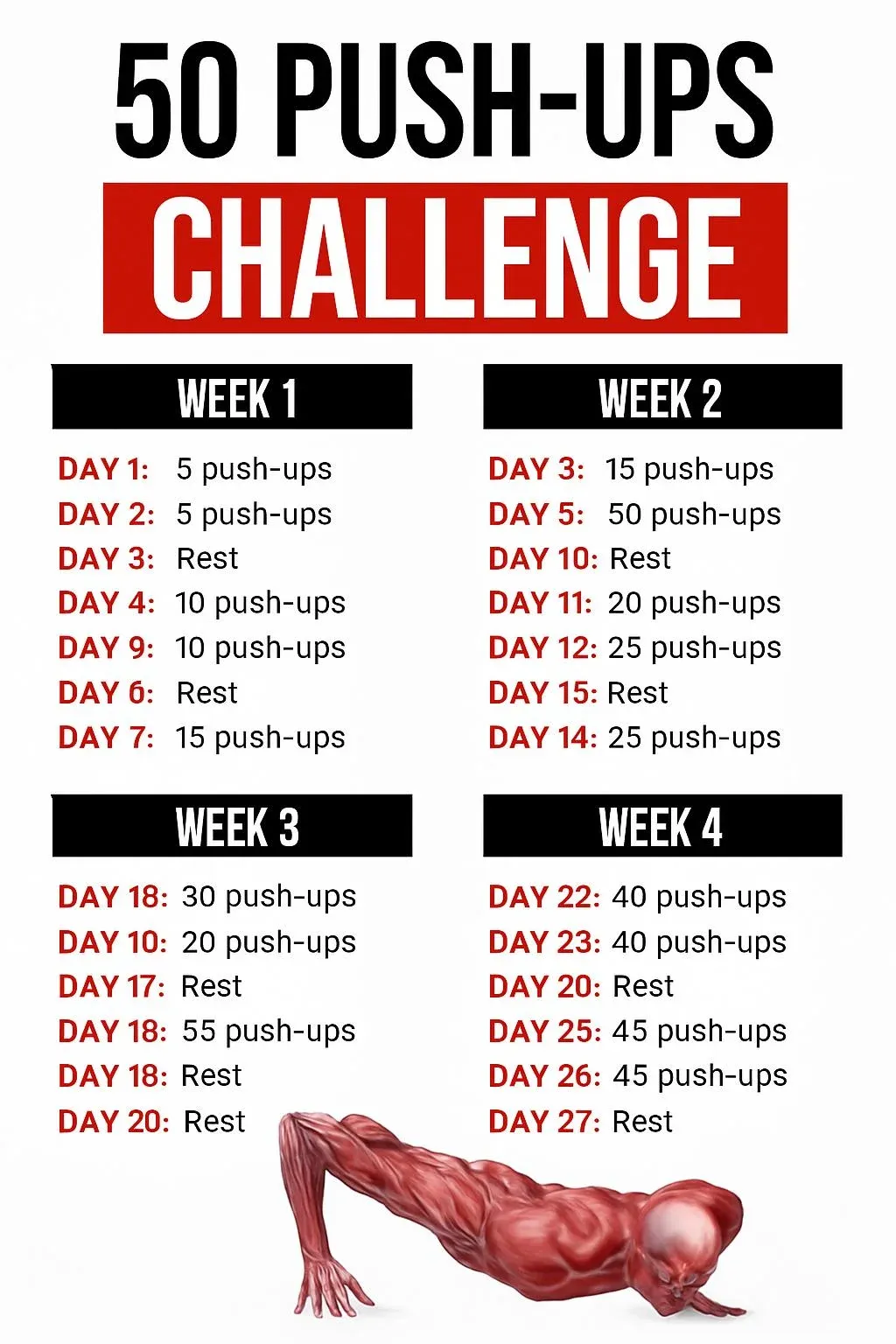
Push-ups are one of the most efficient, no-equipment exercises you can do to build upper-body strength, core stability, and muscular endurance. Whether you’re starting from a few reps or working up from zero, a structured 4-week plan can take you to 50 consecutive push-ups with consistent practice and smart recovery. Try pairing push-up training with targeted back work to keep your shoulders healthy and your posture strong.
Why 50 push-ups?
It’s a measurable goal that tests muscular endurance across chest, shoulders, triceps, and core.
It builds confidence and creates a foundation for more advanced bodyweight moves.
It’s scalable: you can adapt the plan whether you can do 0, 10, or 30 reps today.
Fundamentals of good push-up form
Hands should be slightly wider than shoulder-width, fingers spread.
Body forms a straight line from head to heels — no sagging hips or pike.
Elbows track at a roughly 45-degree angle from your torso.
Lower until your chest is an inch or two from the floor, then press up fully.
Breathe in on the descent, out on the ascent.
Warm-ups and mobility (5–7 minutes)
Light jogging or jumping jacks (1–2 minutes).
Shoulder circles and band pull-aparts to activate rotator cuff and scapular stabilizers.
10–15 scapular push-ups (protract/retract shoulder blades) to prime upper-back control.
The 4-week progression
This plan assumes you do the program 3–4 times per week (e.g., Monday, Wednesday, Friday, optional Sunday). On off days, do light mobility or a short walk.
Week 1 — Build volume and consistency
Test day (Day 1): Perform one maximal set of push-ups to find your starting point (don’t go to failure on training days).
Training days: 5 sets of 50% of your max reps with full rest between sets (2–3 min). If your max is 10, do 5 sets of 5.
Add one daily set later in the day of 60% of your max as a “grease the groove” mini-set to build neural efficiency.
Week 2 — Increase set density
Training days: 6 sets of 60% of your max. Reduce rest slightly (90–120 seconds).
Once per week, perform 2 “ramp” sets: start with light sets and finish with a near-max set to push endurance.
Introduce incline or knee push-ups for 1–2 sets if you need to keep total volume manageable.
Week 3 — Push closer to goal reps
Training days: 4 working sets designed as two heavier sets and two endurance sets.
Set 1 & 2: 75–85% of your current max (enough to fatigue without failing).
Set 3 & 4: As many reps as possible (AMRAP) but stop 1–2 reps shy of failure.
Add one day of tempo push-ups: slow 3-second descent and controlled 1-second up, 4 sets of moderate reps. Tempo work increases time under tension and control.
Week 4 — Peak and test
Reduce frequency slightly to allow fresh muscles: 3 solid sessions early in the week.
Early-week sessions: two heavy sets (near max) and one long set (aim for 70–90% of 50).
Test day (end of week): Attempt 50 consecutive push-ups. Warm thoroughly; attempt once when fresh.
Modifications and regression options
Incline push-ups (hands on bench/wall) reduce load for beginners.
Knee push-ups keep the pattern but lower resistive demands.
Eccentric-only (slow negatives) help if you can’t push up yet: step up (or have partner help) and lower slowly to the floor.
Accessory work to support push-up gains
Planks and hollow holds to strengthen core stability.
Dips or tricep-focused extensions for lockout strength.
Rows and posterior-chain work to balance the pushing volume — consider the primer on back development in the article 50 healthy snacks to fuel recovery when planning nutrition and recovery strategies.
Recovery, sleep, and nutrition
Aim for 7–9 hours of sleep nightly; muscle adaptations happen during rest.
Keep protein intake sufficient (rough guideline: 0.6–1.0 g per pound bodyweight for active trainees).
Hydrate and include anti-inflammatory foods (fruits, vegetables, omega-3s). Smart snacking between workouts can help meet calorie and protein needs while keeping energy stable.
Common mistakes and how to fix them
Rounding the back: focus on core bracing and reduce range of motion until you can keep a straight line.
Flared elbows: cue elbows to track closer to 45 degrees to protect shoulders.
Going to failure every set: preserve technique and avoid burnout — stop 1–2 reps shy of failure for most training sets.
Sample microcycle (for someone who can do ~15 push-ups now)
Monday: Test, then 5×8 (50% of max). Core work.
Tuesday: Mobility and light cardio.
Wednesday: 6×10 (60% of new working max). Shoulder stability.
Friday: Tempo work 4×8 + 2 sets AMRAP.
Sunday (optional): One easy set of 9–10 as active recovery.
Tracking progress
Keep a training log: reps, sets, perceived exertion.
Retest your max every 7–10 days to adjust training percentages.
Record short videos occasionally to check form and posture.
Motivation and consistency tips
Pair the push-up challenge with a habit trigger (e.g., after breakfast or before shower).
Use micro-goals: reaching 20, 30, 40 reps are motivating milestones.
Train with a friend or join an online community for accountability.
Conclusion
If you want a concise, guided resource to complement this plan, consider reading this practical guide on How To Do 50 Push-Ups a Day: A 4-Week Challenge which outlines a similar progression and additional tips for making steady gains.
Bodyweight Chest Workout: Simple, Effective, and Progressable
If you want a compact chest session that requires no gym machine — just your body and a bit of creativity — the classic push-up family is a perfect place to start. These movements build pressing strength, improve shoulder stability, and translate well to weighted lifts. If you want to add a dumbbell layer later, check this practical guide to a focused dumbbell chest routine for twists and incline flies to pair with bodyweight work: dumbbell chest workout guide.
Below is a concise breakdown of why push-up variations work, how to perform them safely, and a sample routine based on 3 sets of 12–15 reps — the same template many trainers recommend for hypertrophy and muscular endurance.
Why bodyweight chest work matters
Accessibility: You can do push-ups almost anywhere.
Joint-friendly progressions: Variations (incline, decline, close-grip) let you modulate intensity without loading the spine.
Transferable strength: Solid bodyweight pressing improves stability and motor patterns used in bench and dumbbell pressing.
Key push-up variations and technique
Standard Push-up: Hands just wider than shoulder-width, core braced, body in a straight line. Lower until chest hovers above the floor, then press up.
Close-Grip Push-up: Hands narrower, elbows tucked more; emphasizes the inner chest and triceps. When you progress to barbell work, learning the proper close-grip mechanics helps — for a technical deep dive see this article on mastering the close-grip technique: close-grip technique guide.
Decline Push-up: Feet elevated on a bench or box to shift load toward the upper chest and shoulders.
Incline Push-up: Hands on a raised surface (bench, step) to reduce load, useful as a regression or high-volume finisher.
Technique tips
Tempo: Try 2 seconds down, 1-second pause, explosive up to build both control and power.
Scapular control: Allow shoulders to protract/retract as you move — avoid rigid shrugging.
Core and glutes: Keep them engaged to maintain a straight plank line.
Range of motion: Work through full range; partial reps have a place for overload but prioritize depth for hypertrophy.
Sample 30–40 minute chest session (no equipment)
Warm-up (5–7 min): arm circles, band pull-aparts or scapular push-ups, light plank hold.
Main sets:
Standard Push-ups — 3 sets of 12–15 reps
Close-Grip Push-ups — 3 sets of 12–15 reps
Decline Push-ups — 3 sets of 12–15 reps
Incline Push-ups — 2 sets of 15–20 reps (as a burnout)
Rest: 60–90 seconds between sets for hypertrophy-style work.
Core finisher (optional): 2 sets of 30–45 seconds plank or hollow hold.
Progressions and adding load
Increase reps, decrease tempo, or add a weighted vest when bodyweight becomes easy.
Pair with dumbbell movements (incline flies or presses) for added stimulus on chest fiber types.
Programming tips
Frequency: Train chest 2 times per week for best balance of volume and recovery.
Volume: Aim for 9–15 sets per muscle group per week depending on experience and recovery.
Recovery: Prioritize sleep, protein intake, and joint mobility — shoulders respond well to regular mobility work.
Final notes
Bodyweight chest workouts are deceptively effective. With thoughtful progressions, varied angles, and attention to technique, you can build a strong, well-developed chest without barbells. Start with solid form, use the 3×12–15 template as a baseline, and layer in resistance or dumbbell variations as you outgrow pure bodyweight.
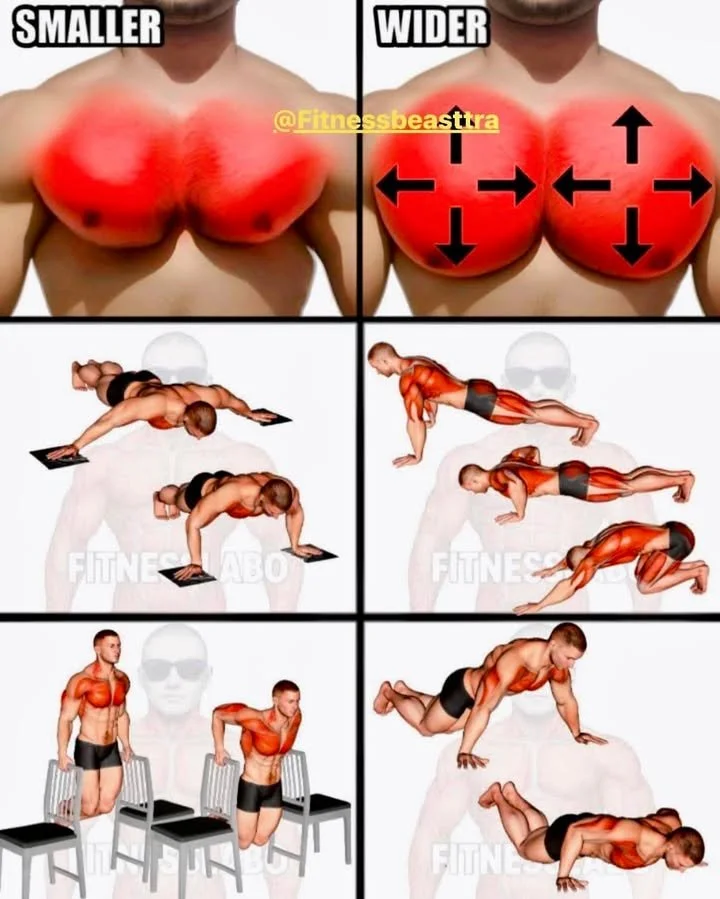
Looking to build strength and muscle in your chest without the need for any fancy equipment? Look no further! Here’s a simple yet effective chest workout routine that you can perform at home, using just a few basic items. This program includes exercises that target the chest muscles while also enhancing overall upper body strength.
Exercise Routine
1. Towel Chest Fly
Description: This exercise mimics the traditional chest fly movement using a towel to create resistance.
How to Do It:
Stand with your feet shoulder-width apart and hold a towel in both hands, stretching it at shoulder height.
With a slight bend in your elbows, open your arms wide, stretching the towel as you do.
Bring your arms back to the starting position.
Benefits: This move effectively targets the pectoral muscles and improves flexibility.
2. Push-up Pull
Description: A variation of the regular push-up that adds a pull component, utilizing momentum and balance.
How to Do It:
Start in a normal push-up position.
As you lower your body, pull one hand toward your body (as if pulling something towards you).
Return to the starting position and repeat on the other side.
Benefits: This exercise works the chest and engages other muscle groups such as the shoulders and arms.
3. Dips Between Chairs
Description: A fantastic bodyweight exercise that focuses on your chest, triceps, and shoulders.
How to Do It:
Place two sturdy chairs a few feet apart.
Support your body weight with your hands on the edges of the chairs and your legs extended between them.
Lower your body until your elbows are at about 90 degrees and then push back up to the starting position.
Benefits: Dips effectively target the lower part of the chest and build upper body strength.
4. Kneeling Push-up
Description: An excellent modification of the standard push-up, perfect for those building strength.
How to Do It:
Start on your knees with hands placed shoulder-width apart on the floor.
Lower your body to the ground by bending your elbows, then push back up to the starting position.
Benefits: This version reduces the intensity of a regular push-up, allowing you to focus on form and muscle engagement.
Workout Plan
Sets and Reps
Perform the following workout three times, completing 15 repetitions for each exercise:
Towel Chest Fly: 3 sets of 15 reps
Push-up Pull: 3 sets of 15 reps
Dips Between Chairs: 3 sets of 15 reps
Kneeling Push-up: 3 sets of 15 reps
Final Thoughts
This home chest workout is perfect for anyone looking to sculpt and strengthen the chest area without traditional gym equipment. Incorporate it into your routine three times a week for optimal results, and don’t forget to listen to your body and rest as needed.
Get ready to unleash the power of your chest with this effective at-home workout routine! 💪🔥
Are you looking to build a stronger, more defined upper body but unsure where to start? Whether you’re a beginner taking your first steps into fitness or an experienced gym-goer aiming to level up your strength, upper body workouts are a cornerstone of any effective fitness routine. From sculpting toned arms and a powerful chest to improving posture and overall functional strength, a well-rounded upper body workouts plan can transform not just your physique but also your daily life.
In this Ultimate Guide to Upper Body Workouts for All Fitness Levels, we’ll break down everything you need to know to get started, or to take your training to the next level. You’ll discover the best exercises for targeting key muscle groups, learn how to create a workout plan tailored to your goals, and pick up expert tips to maximize your results. No matter your fitness level, this guide is your one-stop resource for building a stronger, healthier, and more confident upper body.
1. Why Upper Body Workouts Are Essential for Overall Fitness
Why Upper Body Workouts Are Essential for Overall Fitness
Upper body workouts is a critical component of overall fitness and plays a vital role in both physical health and daily functionality. While many people focus on lower body strength or cardio, neglecting the upper body can lead to imbalances, poor posture, and limited performance in everyday activities. Here’s why building upper body workouts is so important and how it can benefit you:
1. Improved Posture and Spinal Health
A strong upper body, particularly the back and shoulder muscles, helps maintain proper posture. In today’s world, where many of us spend hours sitting at desks or looking at screens, weak upper body muscles can lead to slouching, rounded shoulders, and even chronic pain. Strengthening muscles like the trapezius, rhomboids, and latissimus dorsi helps pull your shoulders back and align your spine, reducing the risk of discomfort and long-term postural issues.
2. Enhanced Functional Strength for Daily Activities
Upper body workouts aren’t just about looking good, they’re about making everyday tasks easier. Whether you’re lifting groceries, carrying your kids, or moving furniture, a strong upper body improves your ability to perform these activities with ease. Functional exercises like push-ups and shoulder presses mimic real-life movements, building strength that translates directly into your daily life.
3. Improved Posture and Reduced Risk of Injury
A strong upper body is crucial for maintaining proper posture, especially in today’s world where many of us spend hours hunched over desks or screens. Exercises like rows and pull-ups strengthen your back muscles, helping to counteract slouching and reduce the risk of chronic pain. Additionally, a balanced upper body workouts routine ensures that all muscle groups are equally developed, preventing imbalances that can lead to injuries.
4. Better Athletic Performance
Whether you’re a runner, swimmer, cyclist, or play sports like basketball or tennis, upper body workouts plays a key role in your performance. A strong upper body improves your ability to generate power, maintain stability, and endure physical demands. For instance, swimmers rely on their shoulders and arms for propulsion, while runners benefit from strong arms to maintain momentum and balance.
5. Balanced Muscle Development for a Toned Physique
If you’re aiming for a well-proportioned, toned physique, upper body workouts are a must. Targeting muscles like the chest, shoulders, arms, and back helps create a balanced look, whether your goal is to build muscle mass or simply tone up. Plus, a strong upper body complements lower body strength, giving you a complete, athletic appearance.
6. Boosted Confidence and Mental Health
There’s something incredibly empowering about feeling strong and capable. Building upper body strength not only improves your physical abilities but also boosts your self-esteem and mental well-being. The sense of accomplishment that comes from mastering new exercises or lifting heavier weights can have a positive impact on your overall mindset.
7. Supports Overall Fitness Goals
Upper body strength is a key component of a well-rounded fitness routine. It complements lower body strength and cardiovascular fitness, ensuring that your body is balanced and capable of handling a variety of physical challenges. Whether you’re aiming to lose weight, build muscle, or improve endurance, upper body workouts are an essential part of the equation.
8. Long-Term Health Benefits
Maintaining upper body strength as you age is crucial for preserving independence and quality of life. Strong muscles help you stay active, reduce the risk of falls, and make it easier to perform daily tasks, even as you get older. Investing in your upper body strength now pays off in the long run.
Upper body strength is about more than just looking good, it’s about feeling strong, capable, and healthy in every aspect of your life. By incorporating upper body workouts into your fitness routine, you’ll not only improve your physical appearance but also enhance your overall well-being. So, whether you’re a beginner or a seasoned fitness enthusiast, don’t underestimate the power of a strong upper body. Start today and experience the transformative benefits for yourself!
2. Key Muscle Groups Targeted in Upper Body Workouts
Key Muscle Groups Targeted in Upper Body Workouts
Upper body workouts focus on several major muscle groups, each playing a unique role in movement, strength, and stability. Understanding these muscles and their functions can help you design a balanced and effective workout routine. Here’s a breakdown of the key muscle groups targeted in upper body workouts:
Chest (Pectorals)
The chest muscles, or pectorals, are located in the front of your upper body and are primarily responsible for pushing movements. Exercises like bench presses, push-ups, and chest flys target this area, helping to build strength, power, and a well-defined chest. Strong pectorals also support activities like lifting and pushing objects in daily life.
Back (Latissimus Dorsi, Trapezius, Rhomboids)
The back muscles are among the largest and most important muscle groups in the upper body. The latissimus dorsi (lats) and trapezius (traps) are key players in pulling movements, such as pull-ups, rows, and lat pulldowns. These muscles help improve posture, stabilize the spine, and create a strong, V-shaped back. The rhomboids, located between the shoulder blades, assist in retracting and stabilizing the scapulae.
Shoulders (Deltoids)
The shoulder muscles, or deltoids, are divided into three parts: anterior (front), lateral (side), and posterior (rear) deltoids. They are responsible for lifting and rotating the arms, as well as stabilizing the shoulder joint. Exercises like shoulder presses, lateral raises, and rear delt flys target these muscles, enhancing shoulder strength, mobility, and overall upper body stability.
Arms (Biceps and Triceps)
The arms consist of two main muscle groups: the biceps (front of the arm) and the triceps (back of the arm). The biceps are involved in pulling and curling motions, such as bicep curls and chin-ups, while the triceps assist in pushing movements, like tricep dips and bench presses. Strong arms are not only aesthetically pleasing but also essential for daily tasks like lifting and carrying.
Core (Abs and Obliques)
While often associated with lower body workouts, the core muscles play a vital role in upper body workouts by providing stability and balance. The rectus abdominis (abs) and obliques (side muscles) help maintain proper form during movements like planks, push-ups, and overhead presses. A strong core also protects the spine and enhances overall athletic performance.
Why These Muscle Groups Matter
Each of these muscle groups works together to create a strong, functional, and balanced upper body. Neglecting any one group can lead to muscle imbalances, poor posture, and increased risk of injury. By incorporating exercises that target all these areas, you’ll build a well-rounded upper body that’s not only powerful but also resilient and capable of handling everyday challenges.
3. Best Upper Body workouts for All Fitness Levels
Best Upper Body workouts for All Fitness Levels
Whether you’re just starting out or looking to challenge yourself, there’s an upper body workouts for everyone. Here’s a breakdown of the best upper body workouts tailored to different fitness levels, ensuring you can build strength and progress at your own pace.
Beginner: Push-Ups, Wall Push-Ups, Resistance Band Rows
If you’re new to upper body workouts, start with bodyweight exercises like push-ups and wall push-ups. These movements build foundational strength without requiring equipment. Resistance band rows are another great option for beginners, as they target the back muscles while being low-impact and easy to modify.
Push-Ups
Targets: Chest, shoulders, triceps, and core.
How to Do It: Start in a plank position with your hands slightly wider than shoulder-width apart. Lower your body until your chest nearly touches the floor, then push back up. Modify by doing knee push-ups if needed.
Why It’s Great: A classic bodyweight exercise that requires no equipment and builds overall upper body strength.
Wall Push-Ups
Targets: Chest, shoulders, and triceps.
How to Do It: Stand facing a wall, place your hands on it at shoulder height, and perform a push-up motion.
Why It’s Great: An excellent modification for those building strength or recovering from injury.
Resistance Band Rows
Targets: Back, biceps, and shoulders.
How to Do It: Loop a resistance band around a sturdy object, hold the ends, and pull toward your torso while squeezing your shoulder blades together.
Why It’s Great: A low-impact exercise that strengthens the back and improves posture.
Once you’ve mastered the basics, incorporate dumbbell bench press, pull-ups, and shoulder presses into your routine. These exercises add resistance to challenge your muscles further, promoting growth and strength. Pull-ups, in particular, are a fantastic compound exercise that engages multiple upper body muscles at once.
Dumbbell Bench Press
Targets: Chest, shoulders, and triceps.
How to Do It: Lie on a bench with a dumbbell in each hand, lower the weights to chest level, then press them back up.
Why It’s Great: Adds resistance to build muscle mass and strength.
Pull-Ups
Targets: Back, biceps, and shoulders.
How to Do It: Grab a pull-up bar with an overhand grip, pull your body up until your chin clears the bar, then lower yourself slowly.
Why It’s Great: A challenging compound exercise that builds upper body power.
Dumbbell Shoulder Press
Targets: Shoulders and triceps.
How to Do It: Sit or stand with dumbbells at shoulder height, press them overhead until your arms are fully extended, then lower them back down.
Why It’s Great: Strengthens the shoulders and improves overhead mobility.
For those with more experience, advanced exercises like barbell bench press, weighted pull-ups, and tricep dips take your upper body workout to the next level. These movements require greater strength and control, helping you push past plateaus and achieve new levels of muscle development.
Barbell Bench Press
Targets: Chest, shoulders, and triceps.
How to Do It: Lie on a bench with a barbell, lower it to your chest, then press it back up.
Why It’s Great: A staple for building upper body mass and strength.
Weighted Pull-Ups
Targets: Back, biceps, and shoulders.
How to Do It: Attach a weight plate or wear a weighted vest while performing pull-ups.
Why It’s Great: Increases the intensity of pull-ups for advanced strength gains.
Tricep Dips
Targets: Triceps, chest, and shoulders.
How to Do It: Use parallel bars or a sturdy surface, lower your body by bending your elbows, then push back up.
Why It’s Great: A challenging bodyweight exercise that builds arm and shoulder strength.
Tips for Progression
Start Slow: If you’re a beginner, focus on mastering proper form before adding weight or intensity.
Gradual Increase: Use the principle of progressive overload by gradually increasing weight, reps, or sets over time.
Mix It Up: Incorporate a variety of exercises to target all muscle groups and prevent plateaus.
4. Creating an Effective Upper Body Workouts Plan
Creating an Effective Upper Body Workouts Plan
An effective upper body workouts plan is more than just a random collection of exercises, it’s a carefully designed routine that targets all major muscle groups, balances intensity, and allows for proper recovery. Whether you’re a beginner or an advanced fitness enthusiast, here’s how to create a plan that works for you.
How Many Sets and Reps to Perform (e.g., 3 Sets of 10-12 Reps)
A well-structured upper body workouts plan typically includes 3-4 sets of 8-12 reps per exercise. This rep range is ideal for building muscle strength and size. For endurance-focused workouts, aim for higher reps (15-20) with lighter weights.
Importance of Rest Days and Recovery
Rest days are just as important as workout days. Your muscles need time to recover and grow after intense upper body workouts. Aim for at least 1-2 rest days per week, and consider alternating muscle groups to avoid overtraining.
Sample Weekly Workout Split (e.g., 2-3 Upper Body Sessions Per Week)
A balanced weekly split might include 2-3 upper body workouts sessions, focusing on different muscle groups each day. For example:
Day 1: Chest and Triceps
Day 2: Back and Biceps
Day 3: Shoulders and Core
How you divide your workouts throughout the week depends on your fitness level and schedule. Here are a few examples:
Full Upper Body Workouts (2-3 Days/Week):
Perform all upper body workouts in one session.
Ideal for beginners or those with limited time.
Push/Pull Split (3-4 Days/Week):
Push Day: Focus on chest, shoulders, and triceps (e.g., bench press, shoulder press, tricep dips).
Pull Day: Focus on back and biceps (e.g., pull-ups, rows, bicep curls).
Allows for more volume and recovery for each muscle group.
Muscle Group Split (4-5 Days/Week):
Dedicate each day to a specific muscle group (e.g., Chest Day, Back Day, Shoulder Day).
Best for advanced lifters looking to maximize muscle growth.
5. Tips for Maximizing Your Upper Body Workouts Results
Tips for Maximizing Your Upper Body Workouts Results
Getting the most out of your upper body workouts requires more than just showing up at the gym or doing a few push-ups at home. To maximize your results, whether your goal is to build muscle, increase strength, or improve endurance, you need to focus on strategy, consistency, and recovery. Here are 7 actionable tips to help you achieve your upper body fitness goals:
Focus on Proper Form to Avoid Injury
Proper form is critical for preventing injuries and ensuring you’re targeting the right muscles. Take the time to learn the correct technique for each exercise, and don’t hesitate to ask a trainer for guidance if needed.
How to Do It:
Learn the correct technique for each exercise (watch tutorials or consult a trainer).
Start with lighter weights to master the movement before increasing intensity.
Avoid using momentum or swinging your body during lifts.
Incorporate Progressive Overload for Muscle Growth
To continue making progress, gradually increase the weight, reps, or intensity of your upper body workouts. This principle, known as progressive overload, is key to building strength and muscle over time.
How to Do It:
Gradually increase the weight, reps, or sets of your exercises.
Reduce rest periods between sets to increase intensity.
Combine Strength Training with Proper Nutrition and Hydration
Your diet plays a huge role in your fitness results. Fuel your body with protein-rich foods, healthy fats, and complex carbs to support muscle recovery and growth. Staying hydrated is equally important for optimal performance during your workouts.
Building a stronger, more defined upper body is within your reach, no matter your current fitness level. With the right exercises, a well-structured plan, and a commitment to consistency, you can achieve remarkable results that go beyond just aesthetics. Upper body workouts not only enhance your physical appearance but also improve your posture, boost your functional strength, and contribute to overall health and confidence.
Remember, progress takes time, so be patient with yourself and celebrate every milestone along the way. Whether you’re performing your first push-up or mastering advanced weighted exercises, every step forward is a victory. Use the tips and strategies in this guide to create a routine that works for you, and don’t forget to prioritize proper form, recovery, and nutrition to maximize your results.
For more expert tips and advanced techniques on upper body workouts, check out this comprehensive guide from Healthline.
Now it’s your turn! Lace up your sneakers, grab those dumbbells (or just your bodyweight), and start your upper body workouts journey today. Share your progress, challenges, and successes in the comments below, we’d love to hear from you! Here’s to a stronger, healthier, and more confident you. 💪
FAQ: Upper Body Workouts
1. Can I Do Upper Body Workouts at Home Without Equipment?
Answer: Absolutely! Bodyweight exercises like push-ups, tricep dips, and planks are excellent for building upper body strength without any equipment. You can also use household items like water bottles or resistance bands for added resistance
2. How Often Should I Train My Upper Body?
Answer: For most people, training the upper body 2-3 times per week is ideal. This allows enough time for muscle recovery while still providing consistent stimulation for growth. Beginners can start with 2 days, while advanced lifters may benefit from 3-4 days with a split routine.
3. How Long Does It Take to See Results from Upper Body Workouts?
Answer: Results vary depending on factors like consistency, diet, and genetics. However, with a proper workout plan and nutrition, you may start noticing improvements in strength and endurance within 4-6 weeks. Visible muscle growth typically takes 8-12 weeks or more.
4. What’s the Difference Between Push and Pull Exercises?
Answer: Push exercises (e.g., bench press, push-ups) target muscles involved in pushing movements, like the chest, shoulders, and triceps. Pull exercises (e.g., pull-ups, rows) focus on muscles used in pulling motions, like the back and biceps. A balanced routine includes both types of exercises.
5. Can Women Benefit from Upper Body Workouts?
Answer: Yes! Upper body workouts are just as important for women as they are for men. They help improve posture, build functional strength, and create a balanced, toned physique. Women don’t need to worry about “bulking up”, building significant muscle mass requires specific training and nutrition.