

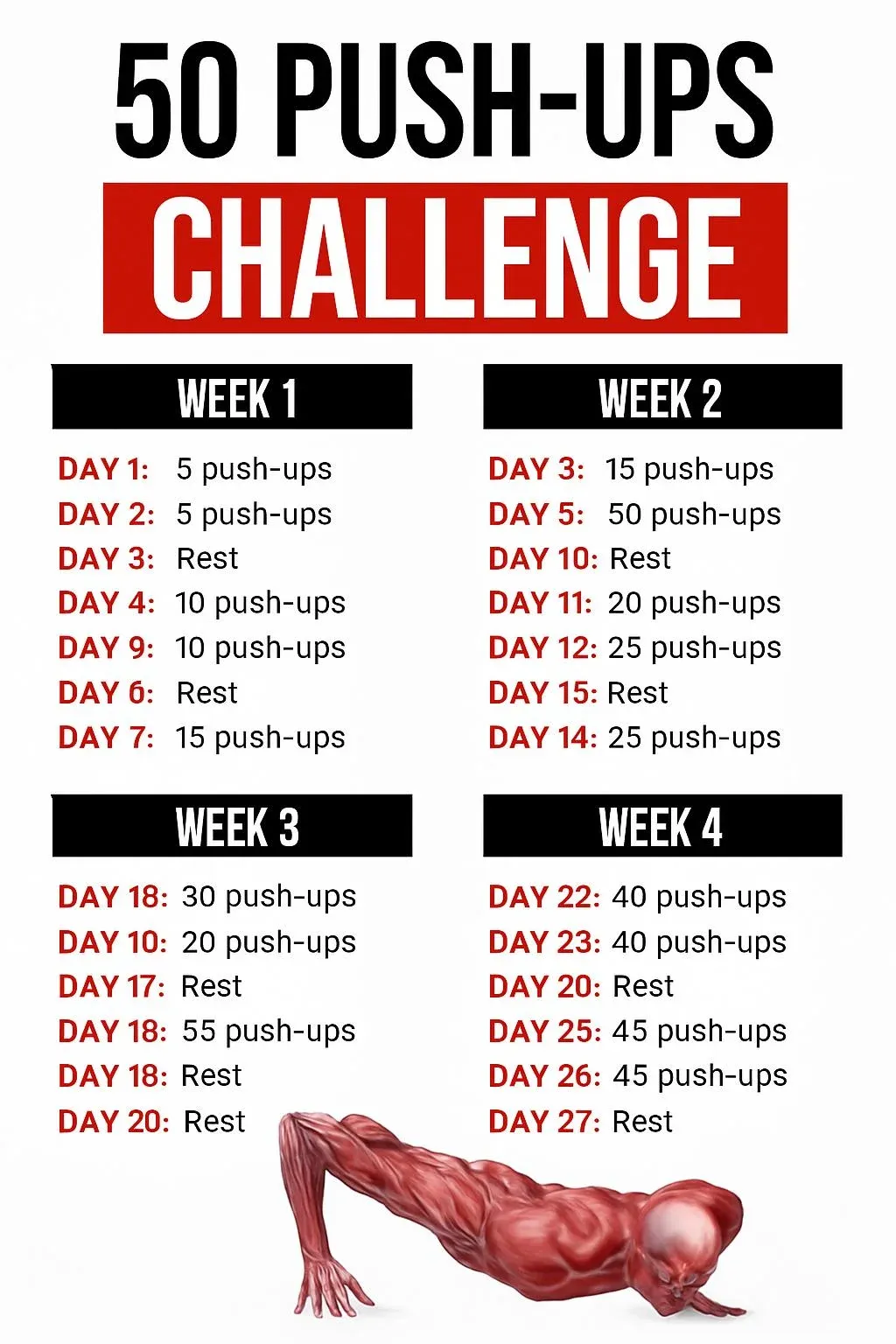
Push-ups are one of the most efficient, no-equipment exercises you can do to build upper-body strength, core stability, and muscular endurance. Whether you’re starting from a few reps or working up from zero, a structured 4-week plan can take you to 50 consecutive push-ups with consistent practice and smart recovery. Try pairing push-up training with targeted back work to keep your shoulders healthy and your posture strong.
Why 50 push-ups?
- It’s a measurable goal that tests muscular endurance across chest, shoulders, triceps, and core.
- It builds confidence and creates a foundation for more advanced bodyweight moves.
- It’s scalable: you can adapt the plan whether you can do 0, 10, or 30 reps today.
Fundamentals of good push-up form
- Hands should be slightly wider than shoulder-width, fingers spread.
- Body forms a straight line from head to heels — no sagging hips or pike.
- Elbows track at a roughly 45-degree angle from your torso.
- Lower until your chest is an inch or two from the floor, then press up fully.
- Breathe in on the descent, out on the ascent.
Warm-ups and mobility (5–7 minutes)
- Light jogging or jumping jacks (1–2 minutes).
- Shoulder circles and band pull-aparts to activate rotator cuff and scapular stabilizers.
- 10–15 scapular push-ups (protract/retract shoulder blades) to prime upper-back control.
The 4-week progression
This plan assumes you do the program 3–4 times per week (e.g., Monday, Wednesday, Friday, optional Sunday). On off days, do light mobility or a short walk.
Week 1 — Build volume and consistency
- Test day (Day 1): Perform one maximal set of push-ups to find your starting point (don’t go to failure on training days).
- Training days: 5 sets of 50% of your max reps with full rest between sets (2–3 min). If your max is 10, do 5 sets of 5.
- Add one daily set later in the day of 60% of your max as a “grease the groove” mini-set to build neural efficiency.
Week 2 — Increase set density
- Training days: 6 sets of 60% of your max. Reduce rest slightly (90–120 seconds).
- Once per week, perform 2 “ramp” sets: start with light sets and finish with a near-max set to push endurance.
- Introduce incline or knee push-ups for 1–2 sets if you need to keep total volume manageable.
Week 3 — Push closer to goal reps
- Training days: 4 working sets designed as two heavier sets and two endurance sets.
- Set 1 & 2: 75–85% of your current max (enough to fatigue without failing).
- Set 3 & 4: As many reps as possible (AMRAP) but stop 1–2 reps shy of failure.
- Add one day of tempo push-ups: slow 3-second descent and controlled 1-second up, 4 sets of moderate reps. Tempo work increases time under tension and control.
Week 4 — Peak and test
- Reduce frequency slightly to allow fresh muscles: 3 solid sessions early in the week.
- Early-week sessions: two heavy sets (near max) and one long set (aim for 70–90% of 50).
- Test day (end of week): Attempt 50 consecutive push-ups. Warm thoroughly; attempt once when fresh.
Modifications and regression options
- Incline push-ups (hands on bench/wall) reduce load for beginners.
- Knee push-ups keep the pattern but lower resistive demands.
- Eccentric-only (slow negatives) help if you can’t push up yet: step up (or have partner help) and lower slowly to the floor.
Accessory work to support push-up gains
- Planks and hollow holds to strengthen core stability.
- Dips or tricep-focused extensions for lockout strength.
- Rows and posterior-chain work to balance the pushing volume — consider the primer on back development in the article 50 healthy snacks to fuel recovery when planning nutrition and recovery strategies.
Recovery, sleep, and nutrition
- Aim for 7–9 hours of sleep nightly; muscle adaptations happen during rest.
- Keep protein intake sufficient (rough guideline: 0.6–1.0 g per pound bodyweight for active trainees).
- Hydrate and include anti-inflammatory foods (fruits, vegetables, omega-3s). Smart snacking between workouts can help meet calorie and protein needs while keeping energy stable.
Common mistakes and how to fix them
- Rounding the back: focus on core bracing and reduce range of motion until you can keep a straight line.
- Flared elbows: cue elbows to track closer to 45 degrees to protect shoulders.
- Going to failure every set: preserve technique and avoid burnout — stop 1–2 reps shy of failure for most training sets.
Sample microcycle (for someone who can do ~15 push-ups now)
- Monday: Test, then 5×8 (50% of max). Core work.
- Tuesday: Mobility and light cardio.
- Wednesday: 6×10 (60% of new working max). Shoulder stability.
- Friday: Tempo work 4×8 + 2 sets AMRAP.
- Sunday (optional): One easy set of 9–10 as active recovery.
Tracking progress
- Keep a training log: reps, sets, perceived exertion.
- Retest your max every 7–10 days to adjust training percentages.
- Record short videos occasionally to check form and posture.
Motivation and consistency tips
- Pair the push-up challenge with a habit trigger (e.g., after breakfast or before shower).
- Use micro-goals: reaching 20, 30, 40 reps are motivating milestones.
- Train with a friend or join an online community for accountability.

Conclusion
If you want a concise, guided resource to complement this plan, consider reading this practical guide on How To Do 50 Push-Ups a Day: A 4-Week Challenge which outlines a similar progression and additional tips for making steady gains.