Rapid Reach: Stroke Arm Recovery Guide
Regaining arm function after a stroke is both a physical and neurological journey. With focused exercises, smart practice, and principles of neuroplasticity, you can accelerate recovery, improve coordination, and reclaim daily activities. Some rehabilitation ideas overlap with general strength training concepts like progressive overload, which you can explore for background context in a complementary resource: progressive resistance principles.
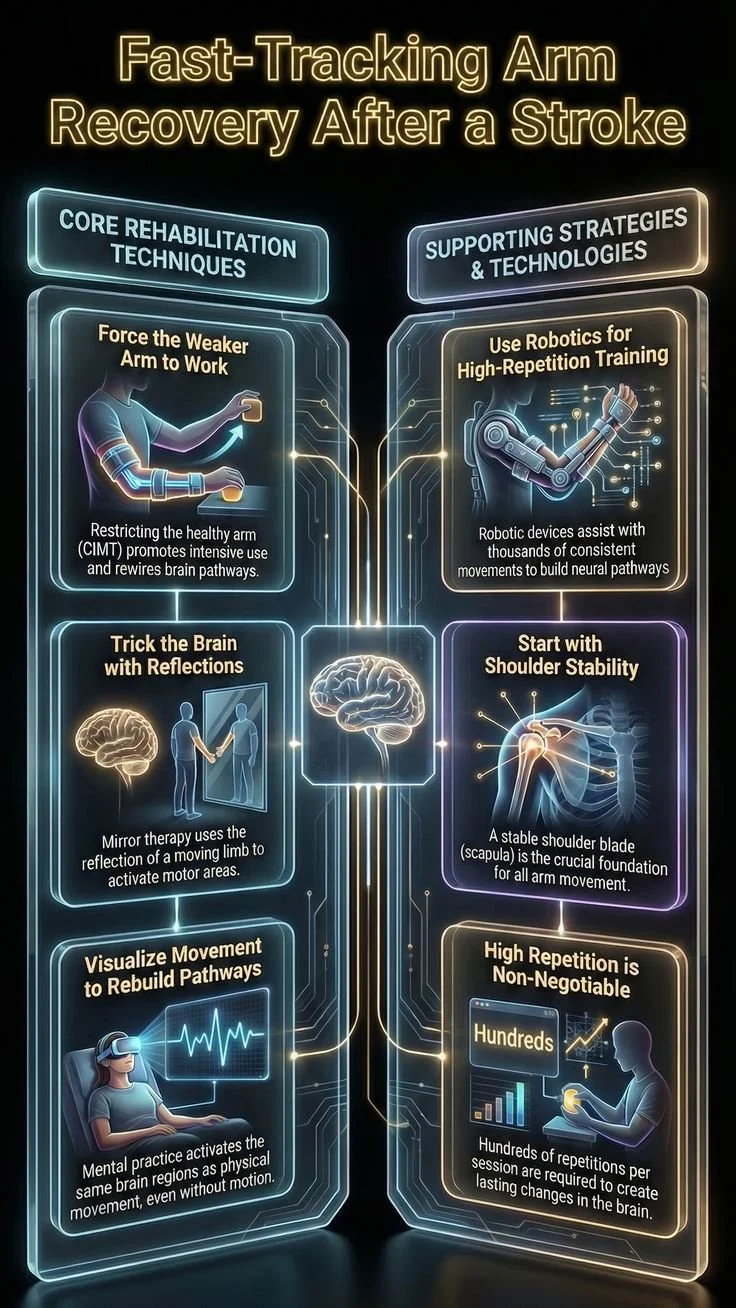
What to expect after a stroke
- Weakness, spasticity, and loss of fine control are common in the affected arm.
- Recovery often progresses from restoring passive range to active, task-focused movement.
- Early, frequent, and meaningful practice drives better outcomes than occasional training.
How stroke changes arm movement
Neural damage disrupts the brain-to-muscle pathways that coordinate reach, grasp, and release. Recovery requires both rebuilding strength and retraining the brain to send precise signals. You can reinforce movement patterns using arm-strengthening strategies adapted for rehabilitation rather than bodybuilder routines: arm-strengthening strategies.
Principles of neuroplasticity to apply
- Use it or lose it: practice the specific movement you want to recover.
- Use it and improve it: increase intensity and challenge over time.
- Specificity matters: task-oriented training produces better functional gains.
- Repetition and timing: frequent, shorter sessions often beat rare long ones.
- Salience: meaningful tasks (making tea, buttoning a shirt) boost learning.
To better understand targeted repetition and how small, focused routines can change muscle behavior, consider reading about structured exercise routines here: targeted repetition and load.
Practical exercises (start gentle, build up)
Passive range-of-motion
- Begin with therapist or caregiver–assisted ROM to maintain joint health.
- Progress to active-assisted movement as control improves.
Scapular and shoulder stabilization
- Sit upright and practice slow shoulder blade squeezes and arm lifts.
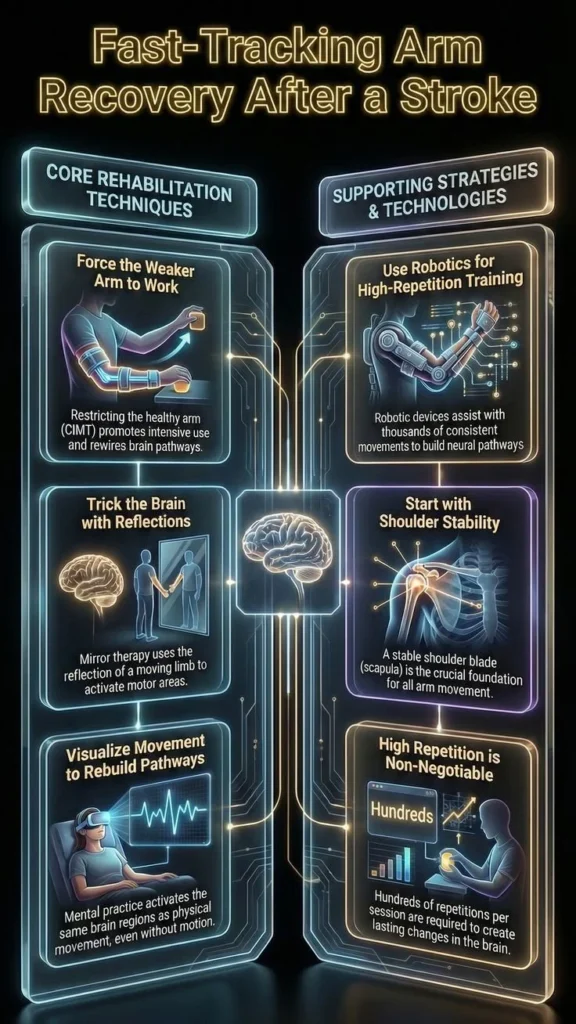
- These foundational moves prepare the shoulder for reaching tasks.
Assisted reach and grasp
- Use the non-affected hand to guide the affected hand through reaching and closing around objects.
- Practice with different object sizes to challenge grip adaptation.
Task-specific practice
- Break daily activities into steps (pick up cup → lift → bring to mouth) and repeat them often.
- Repetition of whole tasks enhances functional transfer.
Strengthening with simple resistance
- Use lightweight bands or water bottles to add graded resistance.
- Gradual increase in load follows the same principles used in vascular and endurance training: vascular and endurance tips, adapted safely for rehab.
Fine motor work
- Finger taps, coin transfers, and buttoning practice refine dexterity.
- Start large-to-small objects as control improves.
Mirror therapy and visual feedback
- Watching the non-affected arm in a mirror while attempting movement with the affected arm can trick the brain into re-establishing pathways.
Frequency and progression
- Aim for multiple short sessions daily (10–20 minutes each) rather than one long session.
- Keep a simple log of repetitions and perceived effort to guide gradual increases.
- Work with a therapist to set safe progression milestones and to monitor spasticity or pain.
Integrating rehabilitation into daily life
Make practice relevant and automatic by embedding exercises into routines:
- Reach for items during kitchen tasks.
- Practice grasp-release during grooming.
- Use a “habit cue” (e.g., after brushing teeth) to trigger a short practice set—home-based adaptations can help you stay consistent: home exercise adaptations.
When to get help
If progress stalls, pain increases, or new symptoms emerge, consult your therapist or physician. A professional can adjust intensity, prescribe modalities (e.g., neuromuscular stimulation), or recommend constraint-induced movement therapy.
Motivation and mindset
Recovery is often nonlinear. Celebrate small wins, track improvements, and vary tasks to keep sessions engaging. Pair exercise with meaningful goals—opening a jar, getting dressed, or writing a short note—to boost salience and persistence.
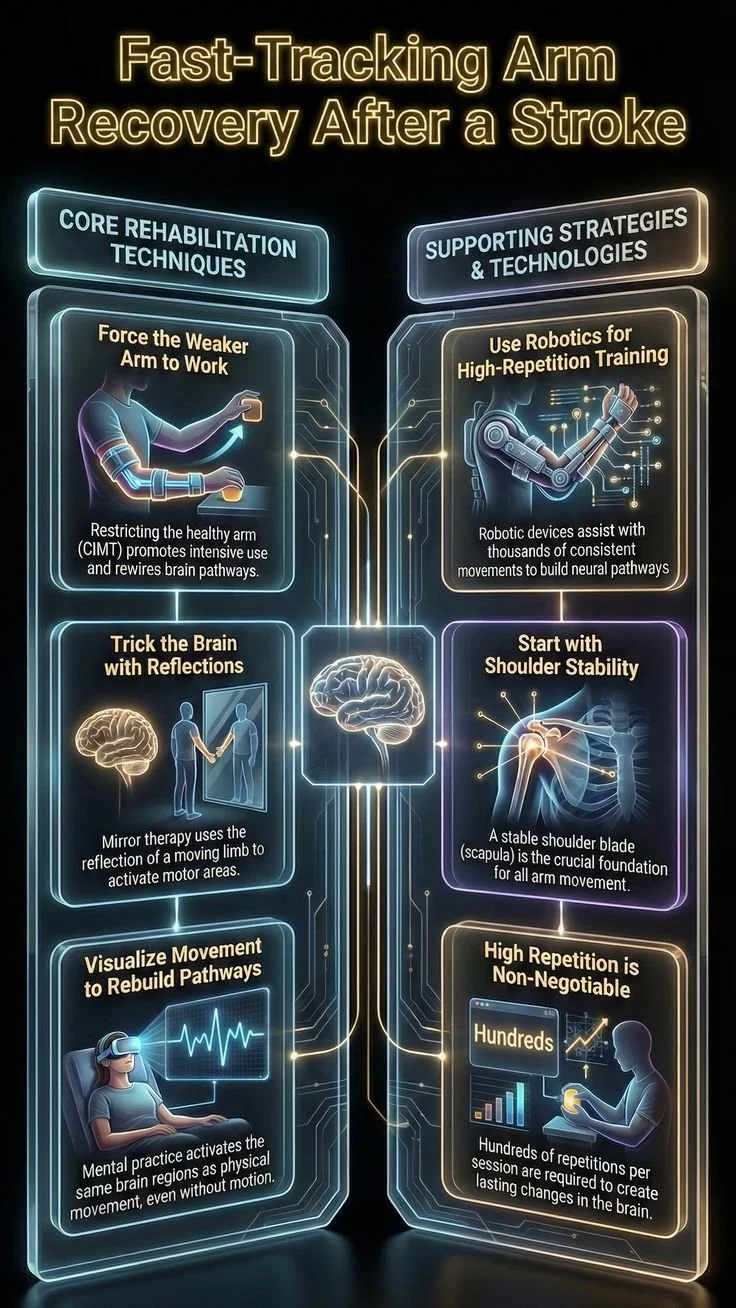
Conclusion
For complementary vision-focused recovery strategies that can pair with arm rehabilitation programs, review these expert eye exercises after stroke for additional multisensory support: vision and eye exercises after stroke.