
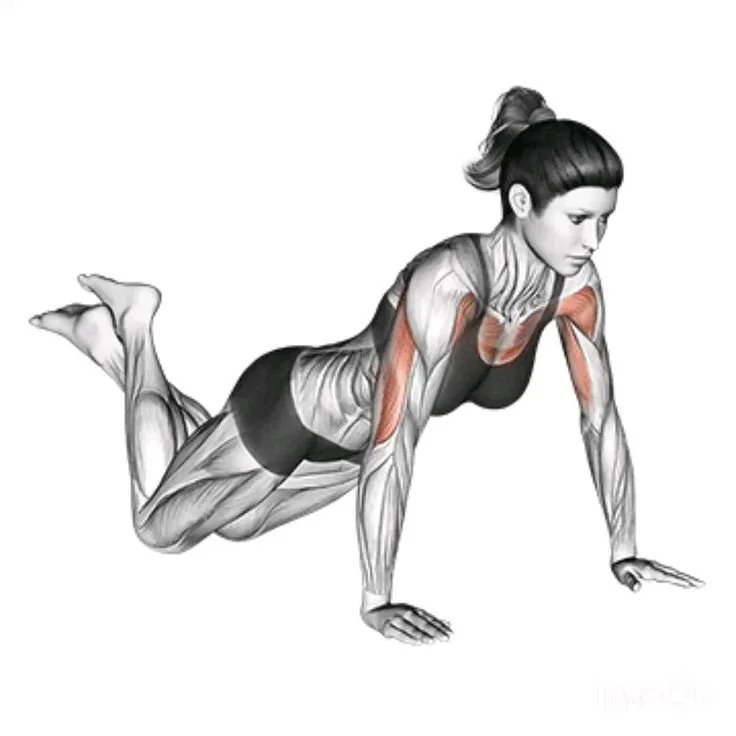
Knee push ups are a beginner-friendly variation of the standard push-up that reduce load while teaching proper pressing mechanics, shoulder stability, and core engagement. They’re ideal for beginners, those rehabbing from injury, or anyone rebuilding upper-body strength after a break. For a step-by-step progression plan, consider pairing this work with a structured program like a 4-week push-up challenge to build volume safely.
Why choose knee push-ups?
Knee push-ups allow you to train the same movement pattern as a full push-up but with less resistance, so you can focus on alignment and muscle activation. They help develop the chest, triceps, anterior shoulder, and the stabilizing muscles around the scapula while placing less stress on the lower back.
How to perform a knee push-up (technique)
- Start on all fours with hands slightly wider than shoulder-width and knees on the ground.
- Walk your hands forward until your body forms a straight line from head to knees; brace your core and glutes.
- Lower your chest toward the floor by bending the elbows, keeping them at about a 45-degree angle from your torso.
- Pause briefly at the bottom without collapsing the shoulders, then press back up until arms are extended.
- Maintain a neutral neck (gaze slightly ahead) and avoid sagging hips.
Common mistakes and how to fix them
- Hips sagging: actively brace the core and squeeze the glutes to keep a straight line.
- Flaring elbows: tuck elbows slightly toward the body to protect the shoulder joint.
- Rushing reps: control both lowering and pressing phases to maximize muscle engagement.
Progressions and regressions
- Easier: elevate hands on a stable surface (wall or bench) to reduce load further.
- Harder: move feet back toward a full plank position or transition to eccentric-focused full push-ups (slow negatives).
- Add tempo work (e.g., 3-second descent) or pause reps at the bottom for extra challenge.
Programming tips
- Frequency: 2–4 sessions per week depending on your goals and recovery.
- Sets and reps: beginners can start with 3–4 sets of 6–12 reps; increase reps or sets as strength improves.
- Combine with accessory work for balanced upper-body development — for example, short targeted routines such as a 10-minute upper-body workout to complement pressing strength.
Variations to keep training fresh
- Narrow (diamond) knee push-ups to emphasize triceps.
- Wide-grip knee push-ups to target the chest more.
- Plyometric knee push-ups (light, controlled push-offs) for power once strength is established.
Conclusion
For deeper insight into how the kinetic chain and scapular mechanics influence shoulder and pressing performance, review the relevant research on this topic: what is the influence of the kinetic chain on scapular muscle activity?




Admiring the commitment you put into your blog and detailed information you provide. It’s nice to come across a blog every once in a while that isn’t the same out of date rehashed material. Wonderful read! I’ve bookmarked your site and I’m including your RSS feeds to my Google account.
Thank you so much for your thoughtful comment! I really appreciate you recognizing the effort that goes into creating fresh and detailed content—it means a lot. I’m glad you enjoyed the read and found it worthwhile. Thanks as well for bookmarking the site and adding the RSS feed—your support truly means a lot. Looking forward to having you back!