Arm Forge: Home Biceps Routine
Build stronger, more defined arms without a gym—just consistent, well-planned work and the right progressions. This short program focuses on biceps hypertrophy and strength using minimal equipment and clear set/rep schemes to maximize time and results. If you want a paired chest-and-arm day, try this chest and biceps dumbbell routine for a balanced upper-body session.
Warm-up (5–8 minutes)
- Light cardio (jumping jacks or brisk march) 2 minutes
- Arm swings and shoulder circles 1 minute
- Band or light-curl warm-up: 2 sets of 12 slow reps to prime the biceps
Equipment options (no gym needed)
- Resistance bands (light, medium, heavy)
- A pair of adjustable dumbbells or household alternatives (water jugs, backpacks)
- A towel for isometric holds or chin-up progression
- No equipment? Use slow tempo bodyweight curls (see variations below)
Core workout structure
- Frequency: 2–3 biceps-focused sessions per week (allow 48–72 hours rest between heavy sessions)
- Rep ranges: Strength: 4–6 reps; Hypertrophy: 8–12 reps; Endurance/definition: 15–25 reps
- Sets: 3–5 sets per exercise
- Tempo: 2 seconds concentric, 1-second squeeze, 3–4 seconds eccentric for max time under tension
Exercises and progressions
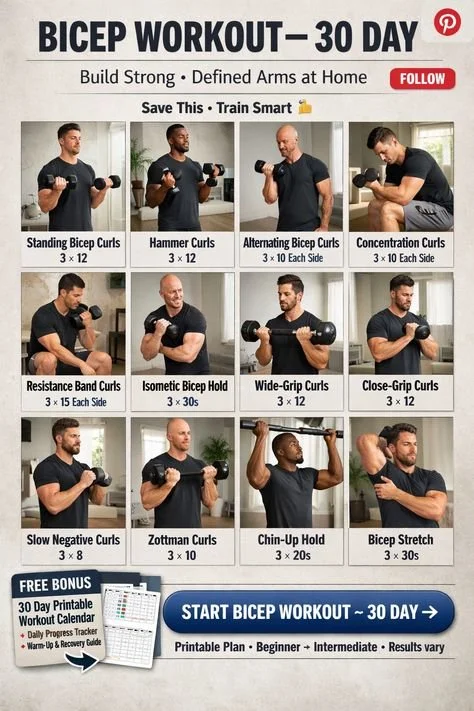
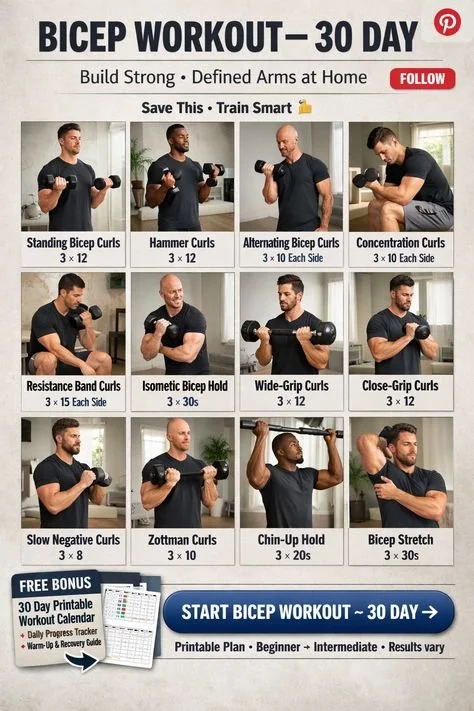
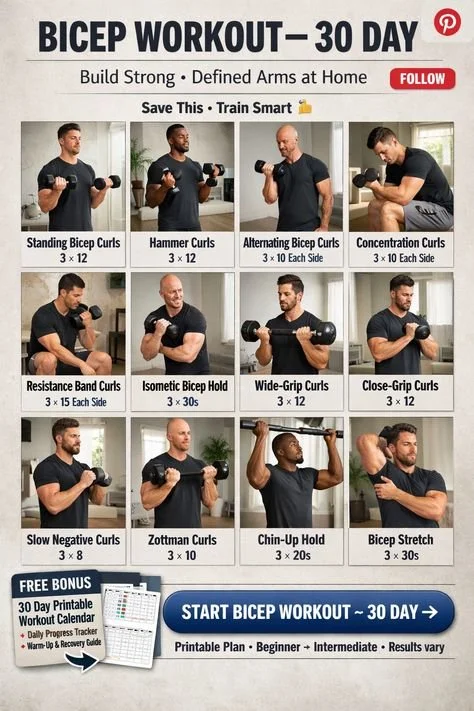
- Resistance-Band Standing Curls
- 4 sets of 8–12 reps
- Anchor band under feet, keep elbows tight to torso, squeeze at the top.
- Dumbbell Alternating Curls (or household weight)
- 4 sets of 8–10 reps per arm
- Rotate the wrist (supination) through the lift for stronger peak contraction.
- Hammer Curls (neutral grip)
- 3 sets of 10–12 reps
- Targets brachialis for fuller upper-arm appearance.
- Incline or Seated Concentration Curls
- 3 sets of 10–12 reps per arm
- Slow eccentric to increase muscle damage and growth stimulus.
- Isometric Towel Hold (no-equipment finisher)
- 3 rounds of 20–30 seconds
- Hold a towel under a heavy object or pull against a partner; focus on sustained tension.
Bodyweight alternatives (if no external load)
- Chin-up negatives: 3–5 reps with 5–7 second lowers
- Towel curls: loop a towel under foot and curl, emphasizing slow eccentrics
- Isometric holds against a door frame or sturdy object
Programming tips for definition and strength
- Progressive overload: increase reps, sets, resistance, or decrease rest every 2–3 weeks.
- Mix rep ranges: one session in the week focuses on heavy low reps; the next emphasizes moderate-high reps with slower eccentrics.
- Nutrition and recovery: adequate protein (rough guide 0.7–1.0 g/lb bodyweight), sleep, and calorie control are essential for definition.
- Cardio and full-body conditioning help reveal muscle definition; see these top picks for comprehensive plans that pair well with single-muscle focus days in this guide to the best full-body workouts.
Weekly sample (beginner/intermediate)
- Day 1: Biceps focus — Band curls, alternating dumbbell curls, hammer curls, towel holds
- Day 2: Rest or light cardio
- Day 3: Full-body or chest-biceps pairing (modify volume)
- Day 4: Rest or mobility work
- Day 5: Biceps technique session — slow eccentrics and isometrics
- Days 6–7: Active recovery and rest
Form cues and common mistakes
- Avoid swinging: use strict elbows-locked-to-sides technique.
- Control the eccentric: a slow return builds more muscle than fast, sloppy reps.
- Full range of motion matters: partial reps have a place, but emphasize complete contraction and stretch.
- Don’t overtrain: more isn’t always better—quality beats quantity.
Quick tracking template
- Note exercise, load (or band tension), sets, reps, and perceived difficulty.
- Aim for gradual progression each week: small increases in reps or load.
Conclusion
For guided daily arm routines and on-the-go tracking, try this dedicated app designed for short, consistent arm sessions: Daily Arm Workout – Trainer App.