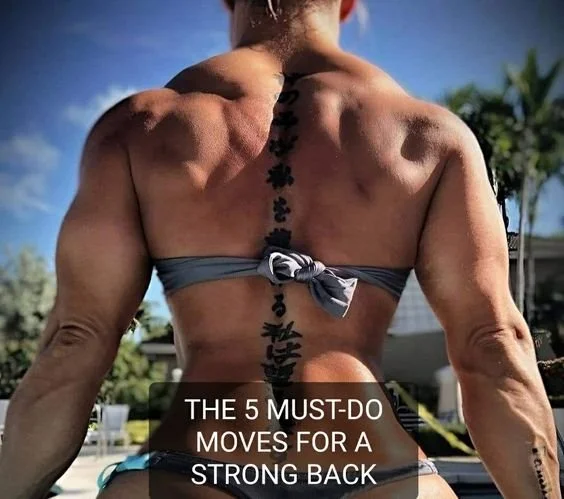
5 Must-Do Back Moves to Build a Massive Back
A powerful, wide, and thick back is one of the best indicators of full-body strength and athleticism. Whether your goal is to look impressive in a T-shirt, improve deadlift numbers, or prevent injury, these five foundational moves should be the backbone of your training. For balanced development, pair your back days with smart lower-body work such as these 5 Bulgarian split squat alternatives to build stronger legs without the balance struggle.
Below are the five essential exercises, how to perform them correctly, programming suggestions, and common mistakes to avoid.
1) Deadlift (Conventional / Trap Bar)
Why: The deadlift is a whole-posterior-chain builder—low back, erectors, lats, traps, glutes, and hamstrings all get stronger.
How to cue it:
- Setup with feet hip-width, grip just outside legs.
- Brace your core, pull lats down and back, and drive through the heels.
- Keep a neutral spine and push the floor away rather than pulling the bar.
Programming:
- Strength focus: 3–6 sets of 3–6 reps with heavy loads.
- Hypertrophy: 3–4 sets of 6–10 reps with slightly lighter, controlled reps.
Common mistakes:
- Hips rising too fast into a stiff-legged position.
- Rounded upper back—pull the shoulder blades down to protect the spine.
- Letting the bar drift away from the shins.
If you want a structured way to practice heavy pulls, try a dedicated protocol like the 15-minute heavy deadlift EMOM workout to build strength fast to build consistency under load.
2) Bent-Over Barbell Row (or Chest-Supported Row)
Why: Rows add thickness to the mid-back and reinforce horizontal pulling strength that balances pressing work.
How to cue it:
- Hinge at the hips, keep a flat back, and pull the bar toward your lower rib cage.
- Lead with the elbows and squeeze the shoulder blades together at the top.
Programming:
- 3–5 sets of 6–12 reps for size and strength.
- Use chest-supported rows if lower-back fatigue limits your ability to maintain position.
Common mistakes:
- Using excessive torso momentum.
- Dominating the movement with the arms instead of lats and scapular retraction.
3) Pull-Ups / Chin-Ups
Why: Bodyweight vertical pulling builds wide lats and functional strength. Changing grip width and hand orientation shifts emphasis across the back and biceps.
How to cue it:
- Start from a full hang, initiate by pulling the chest toward the bar, and avoid shrugging the shoulders up.
- Control the descent on the way down.
Programming:
- Strength: weighted pull-ups, 3–6 sets of 3–6 reps.
- Hypertrophy: bodyweight or assisted, 3–4 sets of 6–15 reps.
Common mistakes:
- Kipping unless intentionally training for it.
- Partial reps—aim for full range of motion.
4) Single-Arm Dumbbell Row (or One-Arm Cable Row)
Why: Unilateral work corrects left-right imbalances, improves lat shape, and allows full contraction at the top of the movement.
How to cue it:
- Keep a braced torso, pull the elbow back and slightly up, and rotate the shoulder blade into the spine.
- Pause and squeeze at the top for 1–2 seconds.
Programming:
- 3–4 sets of 8–15 reps per side.
- Use heavier sets for strength and higher reps for time under tension.
Common mistakes:
- Twisting the torso to cheat.
- Letting the shoulder hike—keep it down and active.
5) Face Pulls / Rear Delt Band Work
Why: The small muscles of the upper back and rear delts improve posture, shoulder health, and the upper-thickness of the back—important for aesthetics and injury prevention.
How to cue it:
- Pull the rope or band toward your face with elbows high, externally rotating at the finish.
- Focus on scapular retraction and posterior shoulder activation.
Programming:
- 3–4 sets of 12–20 reps with controlled tempo.
- Use as a finisher for back or upper-body days.
Common mistakes:
- Using too heavy a load that turns the movement into a row.
- Letting the head jut forward—keep neutral alignment.
Programming Template (Simple Week)
- Day 1 (Heavy): Deadlift variant 4×4, Bent-over row 4×6, Face pulls 3×15
- Day 2 (Volume/Width): Pull-ups 4×8, Single-arm rows 4×10, Rear-delt work 3×15
- Swap in variations weekly (e.g., trap-bar deadlift, chest-supported rows) and prioritize progressive overload.
Recovery and Injury Prevention
- Warm up with banded pull-aparts, light rows, and hip-hinge drills.
- Maintain thoracic mobility to support a strong, safe pulling position.
- Address residual soreness with mobility, foam rolling, and targeted recovery work.
Conclusion
If heavy pulling ever leaves your lower back sore or stiff, follow these practical 5 Steps to Treat Lower Back Pain from Deadlifts to recover safely and get back to building a massive back.