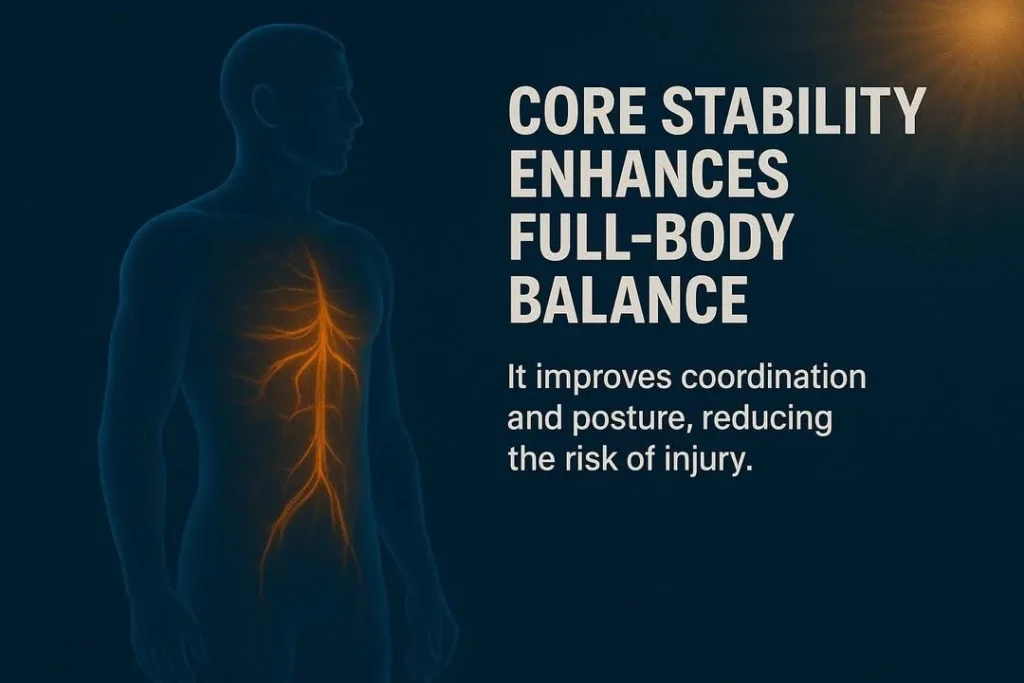
Core stability is more than just having visible abdominal muscles; it is the coordinated strength and control of the deep and superficial muscles that support the spine, pelvis, and hips during movement. Developing functional core stability improves balance, reduces injury risk, enhances athletic performance, and makes everyday tasks easier — from lifting groceries to maintaining posture at a desk.
Introduction
A well-trained core provides a stable foundation for the limbs to generate force and absorb impact. This stability arises from a complex interaction between the diaphragm, pelvic floor, transversus abdominis, multifidus, obliques, and other trunk muscles. For a practical starting point and an accessible exercise to build rotational control, many practitioners recommend variations of resisted twists; see a practical guide to one such approach here: band twist how to build core strength. Understanding core stability helps you choose exercises that transfer to real-life movement rather than just producing aesthetic results.
What core stability means in practice
- Support vs. stiffness: True stability allows controlled motion while protecting the spine, not rigidness that limits mobility.
- Local vs. global systems: “Local” stabilizers (e.g., transversus abdominis, multifidus) control segmental stiffness; “global” movers (e.g., rectus abdominis, erector spinae) produce larger movements. Training both systems in context produces the best outcomes.
- Feedforward activation: The body often pre-activates core muscles in anticipation of limb movement; training can improve this timing and coordination.
Benefits of improving core stability
- Reduced low-back pain risk and improved rehabilitation outcomes.
- Better balance and fewer falls in older adults.
- Increased efficiency and power transfer in sports and lifting tasks.
- Improved posture and endurance for prolonged tasks.
Assessment pointers
Practical assessments help tailor training:
- Static holds: Planks, side planks — evaluate endurance and alignment.
- Dynamic control: Single-leg deadlifts, bird-dogs — observe compensations and pelvic control.
- Functional tests: Rotational throws or loaded carries reveal how the core stabilizes under realistic loads.
Record movement quality, not just time, and note breathing and hip mobility, which greatly influence core performance.
Core stability exercise progressions
Start with breathing and activation, then progress to load and complexity:
- Breathing + activation: Diaphragmatic breathing with gentle transversus abdominis bracing.
- Static control: Front and side planks, dead-bug variations — focus on neutral spine and steady breathing.
- Dynamic control: Bird-dogs, single-leg bridges, pallof press variations.
- Loaded and rotational: Farmer carries, suitcase carries, resisted twists and anti-rotation work. For guided instruction on a rotational band exercise that builds both strength and control, check this practical resource: band twist how to build core strength.
- Sport-specific integration: Plyometrics, change-of-direction drills, and weighted lifts while maintaining trunk control.
Programming tips
- Frequency: 3–4 times per week for beginners; integrate core work into warm-ups and as part of full sessions for intermediates/athletes.
- Sets and reps: For endurance-focused holds, 3–4 sets of 20–90 seconds depending on fitness. For dynamic control, 2–4 sets of 8–15 reps per side.
- Progression: Increase complexity before simply adding load — e.g., move from bilateral to unilateral, add perturbations, then external resistance.
- Consistency and specificity: Train the core in ways that mimic your sport or daily activities for best transfer.
Common mistakes to avoid
- Over-bracing and breath-holding, which can restrict movement and increase intra-abdominal pressure unnecessarily.
- Neglecting hip and thoracic mobility; limited range in these areas shifts demand to the lumbar spine.
- Doing hundreds of sit-ups without addressing stabilization or movement quality — quantity without quality won’t build functional stability.
- Using the core only in isolation; integrate it with limb movements for practical strength.
Rehabilitation and special considerations
- If recovering from low-back pain or surgery, begin with gentle activation and progress under professional guidance.
- For older adults, prioritize balance and anti-rotation holds to reduce fall risk.
- Pregnant or postpartum individuals should seek tailored programs that address diastasis recti, pelvic floor function, and safe loading strategies.
Sample 8-week beginner block (example)
Weeks 1–2: Focus on breathing, pelvic floor activation, 3×/week planks (3 × 20–30s), dead-bugs (3×10).
Weeks 3–4: Add side planks, bird-dogs, and light loaded carries; introduce unilateral balance work.
Weeks 5–6: Progress to pallof presses, single-leg bridges, and increased carry distances.
Weeks 7–8: Introduce more dynamic rotational work, integrated plyometrics, and sport-specific drills, while maintaining a baseline of stability work.
Tracking progress
Use both qualitative and quantitative markers:
- Improved hold times and reduced compensations.
- Better performance in functional tests (e.g., single-leg balance, loaded carries).
- Subjective reports of reduced pain and improved daily function.
Conclusion
For an evidence-informed overview of core stability concepts, mechanisms, and clinical applications, see the resource Core Stability – Physiopedia. This summary can complement practical guides and exercise progressions as you design a balanced, functional core program.