Enhance Your Shoulders: Top 5 Cable Exercises
Strong, rounded shoulders improve posture, boost pressing strength, and give your upper body a balanced, athletic look. Cable machines are ideal for shoulder development because they provide constant tension and allow for smooth, controlled movement through a variety of angles. This guide covers five highly effective cable exercises, how to perform them, programming tips, and common mistakes to avoid.
If you like to combine upper-body work with lower-body or full-body training days, consider pairing shoulder sessions with dedicated glute work for better overall balance — for example, try the routines in this glute exercise guide.
Warm-up: Prep the Shoulders
Before you start loading weight, spend 8–10 minutes prepping:
- 3–5 minutes of light cardio to raise body temperature.
- Dynamic shoulder mobility: arm circles, band pull-aparts, and cross-body swings.
- 2–3 light sets of the first exercise you’ll perform (e.g., cable face pulls) with minimal resistance.
Proper warm-up reduces injury risk and improves muscle recruitment during your main sets.
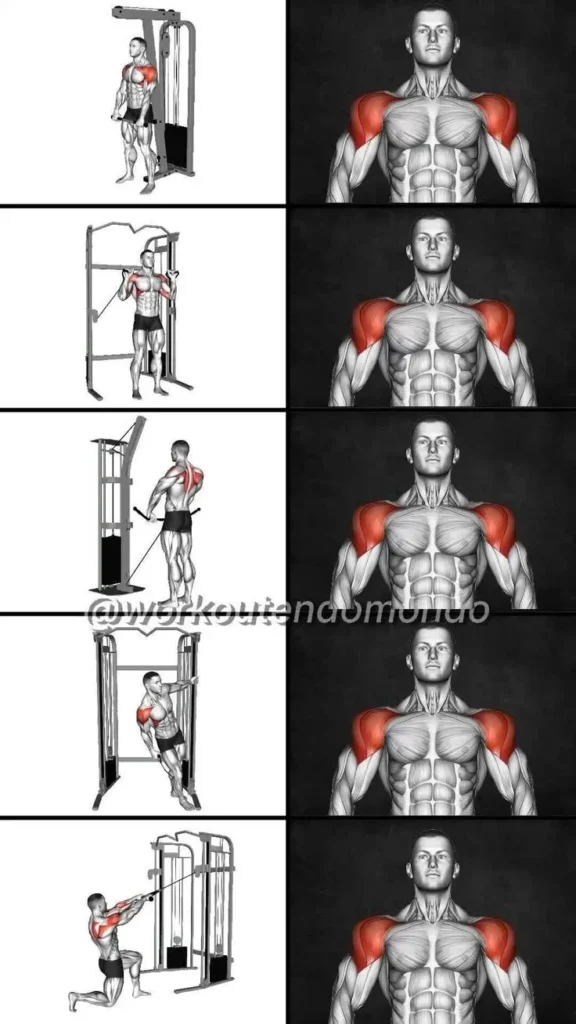
1. Cable Lateral Raise (Single-Arm or Double-Arm)
Why it works: Targets the lateral deltoid head — the primary muscle for shoulder width.
How to do it:
- Set the pulley low. Stand with the cable at your side.
- With a slight bend in the elbow, lift the handle out to the side until your arm is parallel to the floor.
- Pause briefly at the top, then lower under control.
Coaching tips: - Avoid shrugging; keep the neck relaxed.
- Use a moderate rep range (8–15) and focus on a controlled eccentric.
2. Cable Front Raise (Using Rope or Handle)
Why it works: Emphasizes the anterior deltoid and helps with pressing strength.
How to do it:
- Set the pulley near the very low position. Grip a single handle or rope with both hands.
- Keeping arms mostly straight, lift in front of you to shoulder height.
- Lower slowly, resisting the cable on the way down.
Variations: - Single-arm front raises allow correcting left-right imbalances.
- Use a neutral grip (thumb up) to slightly shift emphasis and joint comfort.
3. Cable Face Pull
Why it works: Builds rear delts and external rotators — crucial for posture and shoulder health.
How to do it:
- Set the pulley at upper-chest to head height and attach a rope.
- Pull the rope toward your forehead, flaring your elbows out and squeezing the shoulder blades.
- Control the return; don’t let the shoulders round forward.
Programming tip: For posture-focused work, perform higher reps (12–20) and multiple sets.
Need help integrating core stability for better control during pulls? Check this abs routine to strengthen your midline and support heavy pulls.
4. Cable Upright Row (Wide Grip)
Why it works: Hits the lateral delts and traps; using cables keeps tension consistent.
How to do it:
- Attach a straight bar to a low pulley. Stand close enough so the cable forms a slight angle.
- Pull the bar up toward the upper chest with elbows leading and flaring outward.
- Stop at chest or collarbone height and lower under control.
Safety note: - If you have shoulder impingement issues, limit range of motion or swap for a different exercise.
5. Cable Reverse Fly (Incline or Standing)
Why it works: Excellent for rear delts and upper back — improves shoulder balance and scapular stability.
How to do it:
- Set two pulleys to mid-chest height and cross them (left hand holds right pulley and vice versa).
- Bend slightly at the hips or use an incline bench for support.
- With a soft elbow, open your arms out to the sides, squeezing between shoulder blades.
Mistakes to avoid: - Don’t use momentum; keep the motion deliberate and focused on the rear delts.
Programming Guidelines
- Frequency: Train shoulders 1–3 times per week depending on volume and recovery.
- Reps and sets: For size, aim for 3–5 sets of 8–12 reps on main lifts; include higher-rep accessory work (12–20) for rear delts and rotator cuff health.
- Exercise order: Start with compound or multi-joint movements (upright row variants) and finish with single-joint isolation (lateral raises, face pulls).
- Progressive overload: Increase weight, reps, or improve form week to week.
Also remember to balance shoulder sessions with solid core work to stabilize lifts — fortified abs help transfer force better during standing cable movements.
Common Mistakes and How to Fix Them
- Using too much momentum: Slow down the eccentric and prioritize control.
- Neglecting posterior chain of the shoulder: Rear delts often lag — include face pulls and reverse flies each week.
- Poor posture and scapular mechanics: Strengthen scapular stabilizers and maintain neutral spine during exercises.
Sample Cable Shoulder Workout
- Warm-up: mobility + 2 light sets of face pulls
- Cable Lateral Raises: 4 x 10–12
- Cable Front Raises (alternating arms): 3 x 10–12
- Cable Upright Row (wide grip): 4 x 8–10
- Cable Face Pulls: 3 x 15–20
- Cable Reverse Flys: 3 x 12–15
Finish with 2–3 sets of rotator cuff work or light band external rotations for joint health.
Conclusion
Cables are an incredibly versatile tool for building rounded, functional shoulders because they offer constant tension and easy angle adjustments. For more exercises, progressions, and a structured approach to cable shoulder training, see this resource on 6 Best Cable Shoulder Exercises for Size and Strength.